
The dove brought rest to Noah,
And the dove’s kinswoman Mary
with good oil instead of a leaf,
poured out the symbols of the Son’s rest.
– St. Ephraim
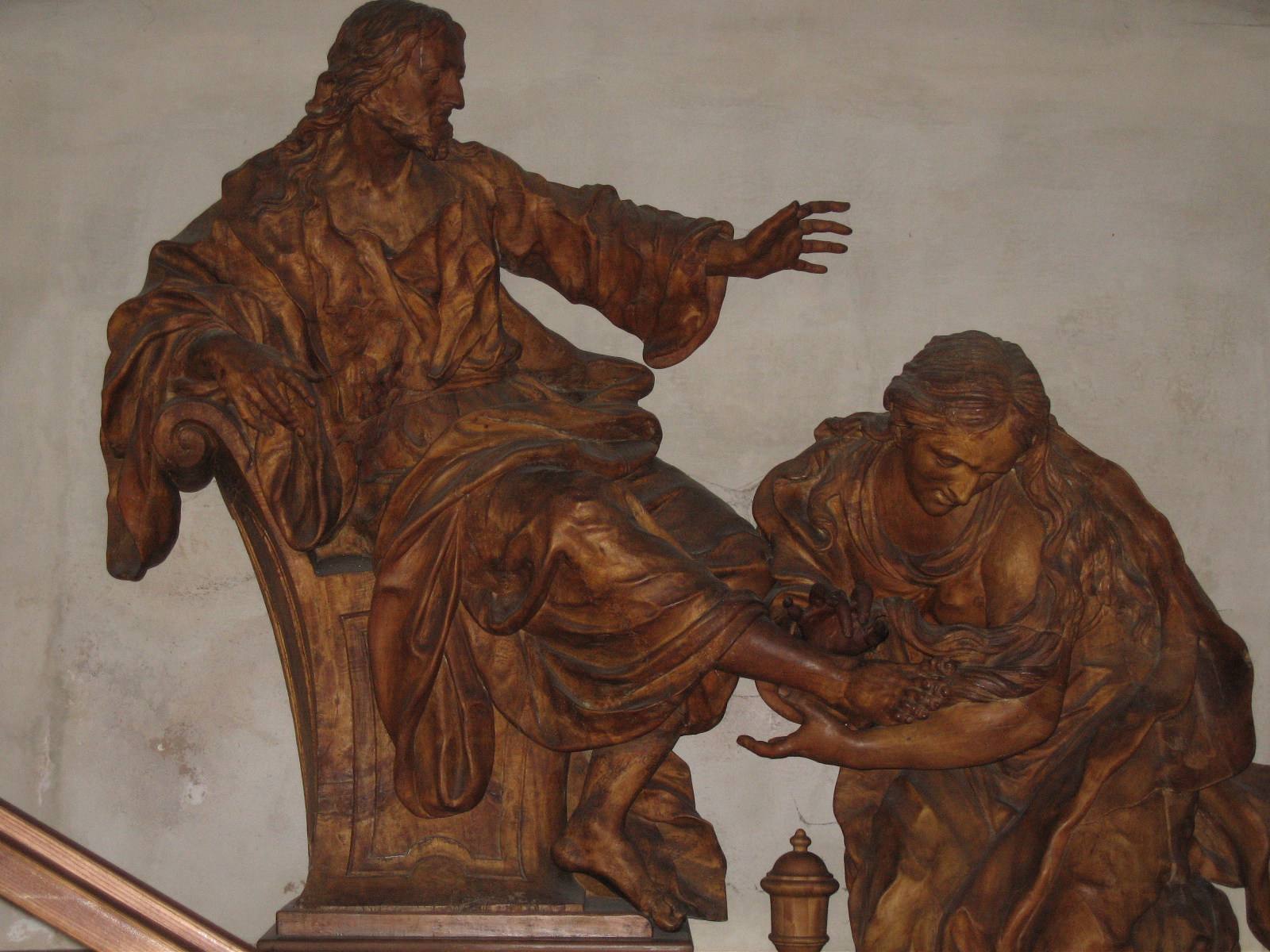
In a discussion of the Chrism Mass, Jack Rakosky suggested that the most appropriate reading would be the anointing at Bethany. This is something I have believed for many years, and it thrilled me to see his suggestion. In fact, I follow this blog in order to understand how liturgists think about the gospel and try to enact it, always with an eye to understanding the story of the anointing better.
The significance of the anointing at Bethany struck me when I read Raymond Brown’s summary statement on St. Mark’s gospel:
Readers can learn much about Jesus from the traditions of his parables and mighty deeds; but unless that is intimately combined with the picture of his victory through suffering, they cannot understand him or the vocation of his followers.
The anointing at Bethany epitomizes this message, as the woman anoints Jesus at the end of his ministry of “parables and mighty deeds” and he reinterprets the anointing as for his coming burial. It is the final pivotal point as the gospel turns to the Passion. Nowhere is the suffering of Jesus more intimately connected with his life of parables and mighty deeds.
St. John, with a very different theology, also uses the anointing as the pivot of his gospel. Mary anoints Jesus as a response to the raising of her brother Lazarus, the last of the signs that make up the first half of the gospel. The anointing also prepares Jesus for his glorification in the second half. It is the anointed Jesus who is welcomed into Jerusalem; he imitates her action when He washes the feet of the disciples; and of course, Jesus dies and is buried, fulfilling that meaning of the anointing.
Despite the prominence these evangelists give to this story, exegetes rarely treat it as important. I did not expect to find it featured prominently by liturgists. But I found some glaring gaps into which this story fits easily. The Chrism Mass is celebrated two days before Easter, which parallels the anointing two days before the Passover. In the morning the bishop could preach to his priests about the anointing of Jesus, and in the evening those priests preach to their people about Jesus copying the position of the woman to wash his disciples’ feet. Rather than a Chrism Mass with a pragmatic timing and purpose, it would be part of reenacting the gospels and preparing us for the death and Resurrection of Jesus.
There is an even larger hole gaping in the sacraments. As a prayer for healing, the anointing of the sick is a powerful sacrament, but as a reenactment of the anointing Jesus received before he suffered, it becomes a more resonant sign of the value of suffering. The oil of catechumens becomes a preparation to be buried with Christ in Baptism. By giving the Holy Chrism roots in Scripture, we take a step toward finding for Confirmation the theology many have sought. The love the woman expresses by anointing Jesus is the love we feel for our children and for those who join our Church. It is stronger than death. And by being anointed as Christ was anointed, we become a part of the Body of the Anointed, able to exercise the authority of Christ by prophetically speaking Christ’s love, by royally choosing to love, and by offering our lives as he did.
There is much more to this story than has generally been acknowledged. The ideas here but skim the surface of the issues in exegesis, the sacraments, Christology, women, etc. But even if I am wrong about everything I say, I hope that you will give greater consideration to what this woman did. Wherever in all the world the gospel is proclaimed, what she has done will be told in memory of her.
Jim McKay
Please leave a reply.