
[UPDATE 15/08/2024 23:57 : GIA Publications requested that the intro image to this blog containing an image to the score of Blest Are They by David Haas, as well as the VIMEO video in which the Eucharistic Prayer from the Mass of Light is referred to be removed on grounds of copyright ownership. The editorial team of PrayTell did so as part of its policy and notified the author as soon as possible.]
Introduction
I have put off writing this post for almost two years now, in part to give a sensitive topic time to develop and see what wisdom might emerge, but also because it is a discussion that can cause strong disagreement so discernment is necessary. The impetus for the post occurred when I wrote to a musician colleague in the United States. I asked if Blest Are They by David Haas was a suitable choice for the Feast of All Saints. He said it was, but then lamented the fact that within the Roman Catholic diocese where he works music by Haas had been banned. My friend filled me in and I did some Googling. Ministering a world away from the USA I had no knowledge of the situation. Our church ultimately did go on to sing Blest Are They and we have continued to use music by the composer for reasons I hope become clearer below. Though I should note this is not the primary focus of what follows.
Following the conversation with my American colleague, just a few days later Channel 4 in the UK announced a TV special called Jimmy Carr Destroys Art. The previews explained that works of art created by morally dubious persons would be put on trial before a studio audience. Professional social historians, art critics, and psychologists would argue for and against a work of art. The stated intention of the program was to “question whether one can truly separate a work of art from its creator.” Following debate the audience would then vote whether Carr should destroy the work of art. Channel 4 promoted the idea saying the show would celebrate the channel’s long tradition of “iconoclasm and irreverence”. In fact, Channel 4 had been quietly purchasing works to be condemned and destroyed. When the show finally aired the audience voted to destroy a watercolor by Hitler, works by the convicted pedophile Rolf Harris and sexual abuser Eric Gill (whose work famously adorns churches throughout England), but the audience chose to save a sculpture by Picasso.
Within days of Jimmy Carr Destroys Art being announced the debate around the liturgical art of the mosaicist and priest Marko Rupnik flared up again. The same issues regarding artistic creation and personal morality were involved. Following upon the convergence of these three events I thought a post on PrayTell was in order, but I decided to wait.
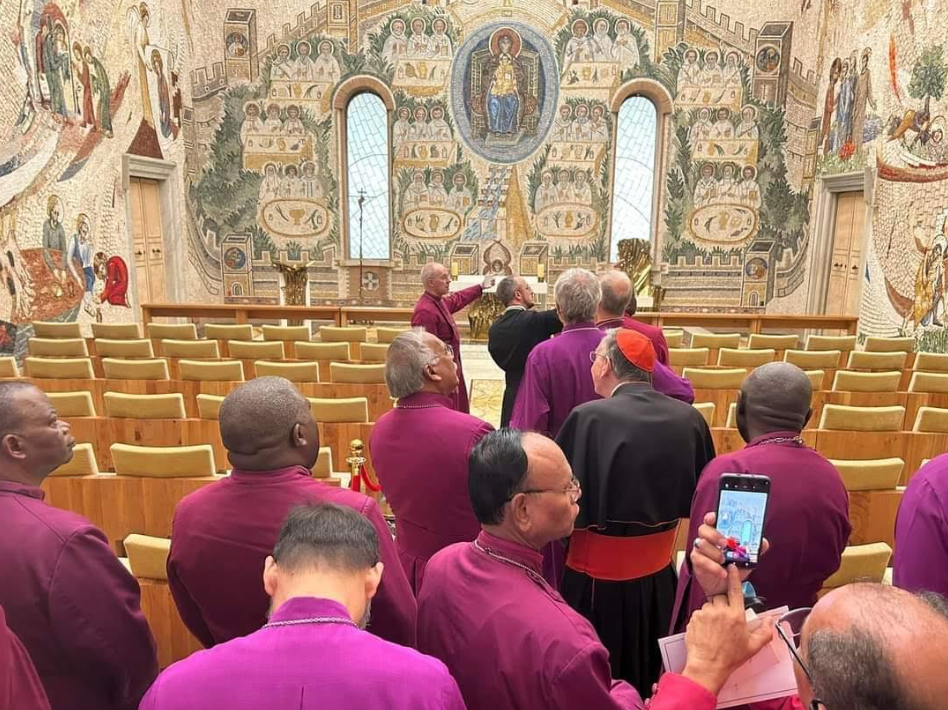
In the intervening two years the debate regarding art by Rupnik and Centro Aletti have continued apace, popping up in Catholic media on a regular basis. I imagine at this point most readers of PrayTell have some knowledge of the ex-Jesuit, the claims of sexual and spiritual abuse made against him, and also the prolific artistic output of the Centro Aletti that Rupnik founded in Rome, but which now operates independently. The various discussions in the press have produced heat, at times a lot of obscuring smoke, but in my considered opinion, little light. Recently when the Vatican prefect Paolo Ruffini was asked about Rupnik he suggested, “Removing, deleting, or destroying art does not ever mean a good choice”. In response to his words, now retired Cardinal Seán O’Malley shared what he thought the Vatican’s response to the situation should be, at least in terms of the Vatican’s continued use of the art in its publishing and social media. Perhaps not coincidentally, Ruffini’s words came not long after the Anglican Primates’ pilgrimage to Rome in which they were given a guided tour of the Redemptoris Mater chapel – the most renowned work of Marko Rupnik and the Russian artist Alexander Kornooukhov commissioned by St John Paul II. One had to look quickly. The photos of the visit were quickly scrubbed from the internet – by Romans and Anglicans alike. This occurrence made me think that the time had come to share my thoughts on PrayTell.
What follows is a bit piece meal given the multiple issues involved and admittedly long for a blog format. But I believe a serious conversation deserves detail, thoughtfulness, and attention. I hope the ideas that follow might contribute some precision to conversations that can oftentimes feel stilted, pre-determined, pugilistic, and yes, emotion laden.
Insights from art criticism
Firstly, art is far more phenomenological than it is ontological. By this I mean that far too often a static identity is assigned to a work art. For much of art history the “meaning” of a work was identified at the level of iconography – what the work depicted. This focus eventually gave way to a hyper-emphasis upon self-expression being inseparable from, or even defining, the meaning of a work of art. This emphasis upon the artist grew even stronger as contemporary art abandoned representational approaches. Standing before such ephemeral works the onlooker now regularly ponders, “what is this artist trying to express?” “What is this artist trying to say?”. It is assumed that the art-object speaks on behalf of the creator.
Philosophers, art-historians, and critics recognise today the insufficiency of understanding art in such a binary fashion. Aby Warburg, a 19th century German art historian sought to more correctly define art through its afterlife. The afterlife concept shifts critical attention away from the intention of the artist and the work’s moment of creation. Art, in this view, is not simply a continuing memory of its invention. Rather, art afterlife considers the work as an event across time that relativises its origin. A work of art “becomes”, rebelling against its origin and thereby reframing itself through social independence. As the work of art “exists” it finds its meaning through its eventfulness, its being in the world, which is descriptive rather than imputed. The critical historian or informed onlooker then encounters the work by penetrating and passing beyond its superficial aspects by understanding the works pre- and post-histories (creation/after-creation) thereby gaining a demystified picture of the meaning of the work. This is to say, there is no singular event or perspective that defines the totality of a work. Any work is transcendent and shifting.
A ramification of this phenomenological freedom is that through its afterlife a work of art exists radically independent of its creator, who may admittedly be a genius or sociopath. In this view the meaning or value of a work is not determined by particular relationships with persons. This was precisely the cynicism exhibited in the Channel 4 programme. It actually served to judge artists through the medium of their art, working backwards as it were. The distinction is poignant; the reality is, art as an object may depict images, or even meanings that we find distasteful or sinful. But art itself does not sin. Art has no moral agency. Only living willing sentient beings have agency. Thus what we protest about distasteful art as a created artifact is not its sinfulness but our projection of a moral status upon the work. For this reason, while framing art morally the onlooker must beware that our projection may or may not be equal to the content of the work as a thing – there is no essential connection; A work may present a theme that is generally agreed is distasteful, and we might indeed find it distasteful. Or a work may present a theme that is holistic or neutral, yet we might find the work distasteful. It is this disconnect and radical independence that establishes art, as art, including the works of Rupnik. Concretely this means, for example, that an average image of the Resurrection or the Saints is not sinful. Perhaps the observer does not like the aesthetic character of the image, or dislikes the creator, but the image itself has no distortive effect upon the conscience of the onlooker. Furthermore, one may bring mental concepts to a piece, or a certain piece of knowledge to the work that makes one uneasy about the artist, but this is about our problem with the artist. It has little to nothing to do with the work of art itself. The point is self-evident. When a few view a work of art and take issue, but tens of thousands do not, one can most likely be assured that the problem is not the work of art. Indeed it is often the case that a certain level of propaganda must be carried out to raise iconoclastic sentiment against a piece so that the masses then begin to “see together” something in a negative way. The Channel 4 programme accomplished just this. Had the name “Hitler” not been attached to the benign watercolor landscape, and had a “public” not been assembled and persuaded, no one would have given the work any mind – it would have continued to exist as a B-class pastoral image. Perhaps hanging on a museum wall it may have been a curiosity that Hitler painted it, but it is highly unlikely that the reaction of the viewing public would have been to assign the guilt of its maker’s crimes to the piece, raise a riot and demand its destruction.
What is noteworthy therefore is that art afterlife is a potent antidote to the notion that the moral character of an artist is carried by a work, or that art (or even architecture) somehow conveys guilt, personal or social. Indeed, art’s afterlife allows the possibility that the work of art “redeems” itself on its own terms before would-be dejectors. There are occasions in which the work of art overwhelms and rebels against attempts to fix a negative identity upon it. I was struck to come across just such a case regarding the Eucharistic Prayer from David Haas’ Mass of Light.

In a Vimeo video (see image above) celebrating a clergy retirement, the composition takes on a life of its own as it is celebrated for its profound effect upon the prayer of the local church. In the testimony of the community the identity of the composer and his personal life are absolutely irrelevant both to the composition and the power of the piece to repeatedly shape moments of graced encounter – even though some in the community surely know the provenance of the setting.
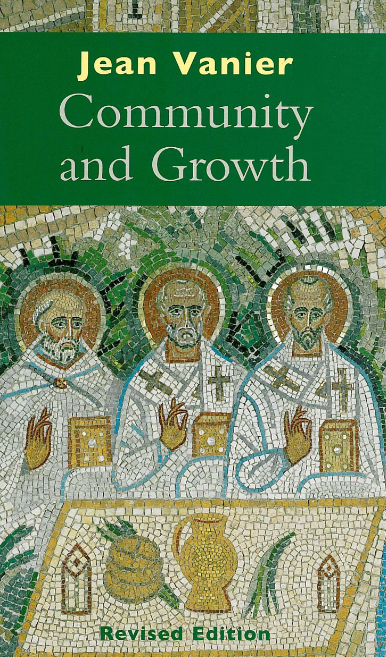
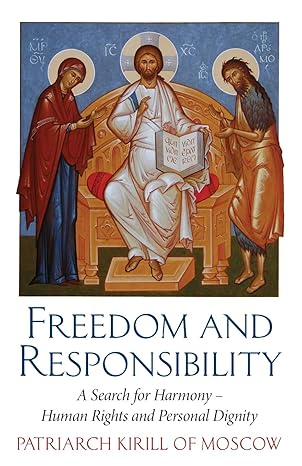
Similarly, I have on my bookshelf Community and Growth by Jean Vanier, and Freedom and Responsibility by Patriarch Kirill of Moscow. Vanier’s shocking abuse within the L’arche community, and Kirill’s declaration of a Holy War against Ukraine in which thousands of Ukranians have died, are to be denounced. But these two books still remain full of beautiful insight, full of truth, we might even say, even now knowing what we know about the authors. Must the owners of such books destroy them, or feel morally culpable for participating in the sins of their authors when reading? Should such works be banned on the basis of personal lives of the author? Should the content of such books not be quoted, as if to do so would participate in the sins of the author? Artistic afterlife suggests otherwise. The true, the good, and the beautiful, can be found in works of art independent of the morality of their creators. Indeed in the radicality of the afterlife such works may even stand as silent and unknown testimonies against the moral inadequacies and contradictions of their creators. The reality is contemporary art criticism has moved beyond seeing art as mere self-expression. It has moved beyond locating the meaning and value of a work of art in the idea that it is a reflection and artifact of the artist’s inner world. Art exists otherwise: beyond a shadowy reference to an originating intention, or even more problematically, a given personality.
A theological perspective
But looking beyond an art critical approach, it is not as if the church has not dealt with this question previously, as if the relationship between art and sinner is somehow only a contemporary conundrum. The theological tradition of the church also contains insight. In this respect, I suggest that there is a strong reason to turn to the Donnatist controversy of the fourth to sixth century. Here the church decided that the personal morality of a priest does not affect the efficaciousness of the sacraments. Augustine’s interpretation of the issue resolved the conflict by defining the priest as the efficient cause of the sacrament, thereby essentially bypassing the humanity of the priest all together. Augustine’s workaround to the Donastist assertion that clergy must be faultless for their ministry and prayers to be effective and sacraments to be valid, was absolute. But between the later highly mechanistic view of Augustine, and the hyper-personalist view of the Donatists, the papal legates to various earlier regional synods tried to suggest that a priest, who was trying to do the will of Christ and the church, aside from any personal fault, ministered in good faith not apart from himself (as Augustine would have it), but in spite of himself. This position thereby did not discount the priest’s human condition in the working of ministerial grace, but neither did the human capacity of the minister define the character or boundaries of grace. To my way of thinking, there is a parallel in the vocation of the (liturgical) artist. That is to say, when a work of art is produced by one who is attempting in good faith to create a work to serve the church in accordance with the regulations set out by the church, the work is not somehow morally deficient or invalid or up for iconoclastic destruction should it later be discovered that the creator of the work was a moral deviant. Just as the sacraments and the good ministry of a morally compromised priest remain efficacious.
In related fashion I find the theological parallel compelling when we consider the status of liturgical art as a sacramental of the church. Indeed such a position is reflected in the fact that the Roman Catholic Book of Blessings has prayers for blessing art objects. That is, the point of the blessing is to effectively set the object aside, sanctifying the object by detaching it from its pre-history and placing it in the operation of grace by pointing its use towards God. A similar dynamic is found in the Order of Dedication of a Church and Altar. Here the building and its contents are set aside for the worship of God in an act of radical faith that God redeems all. In both contexts, the act of blessing signifies the permanent sanctification and dedication of an object for some sacred purpose (Code of Canon Law, 1171). Indeed, when a direct act of desecration occurs, meant as an assault upon the sacred, the object is not usually removed or destroyed unless it is beyond repair. Rather, prayers are offered to re-affirm the sacrality of the place and/or object. All this suggests that sacred art approved and installed cannot somehow arrive pre-desecrated, or be conceptually desecrated after the fact by a type of moral transference which takes place out of space and time. Treating art or architecture as if it is somehow “tainted” with the sin of the artisan, would call into question the very motive for and relevance of blessings and dedications of liturgical art and architecture. Once again, sacraments and sacramentals remain objects of grace apart from questions of personal holiness.
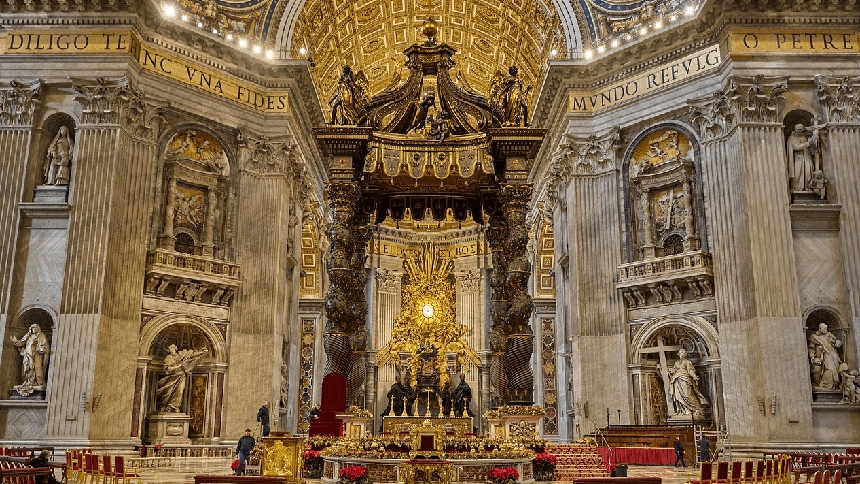
The Donatist controversy says to me that the church is well aware of the foibles, and at times true evils, of the human subject. Throughout history morally questionable artists have always served the church, just as clergy and laity have. Caravaggio, Cellini, Borromini, and Bernini all served the church, and all were involved in either rape, mercenary combat, murder, extortion, suicide, slander, and in most cases more than one. The visitor to Rome would do well to remember that Bernini tried to kill his brother who was sleeping with Bernini’s married mistress Costanza Bonarelli. When Bernini failed to kill his brother by beating him with an iron bar, he had his henchman brutally scar Costanza’s face in the hope that no one would want her. It is also the case that beyond Bernini, Baroque period artists who decorated churches, regularly designed sets and costumes for the theater, which was considered supporting social degradation, composed sexually immoral plays for the theater, and they even produced pornographic engravings for the print market. These artists, and those like them throughout history, were employed by the church and enjoyed significant patronage – sometimes with the knowledge of the artist’s personal life, sometimes without. Closer to our day St Pope John XXIII commissioned the Italian bronze artist Giacomo Manzù to produce the Door of Death for St Peter’s Basilica. Pope John did so knowing that Manzù was a publicly avowed atheist for which he had been previously rejected for Vatican commissions. Today the example seems benign, but in the age when the Syllabus of Errors still held sway, atheism was a mortal sin being an outright rejection of saving grace and the church. Thus by commissioning Manzù, John XXIII further demarcated a line of division between works of art in the service of the church and the personal beliefs and behaviors of artists, a trajectory that St Pope Paul VI continued. Indeed, the twentieth century in particular was marked by the ongoing debate in the church whether the personal lives of many internationally celebrated contemporary artists, often at times clearly and publicly anti-Christian in lifestyle, precluded their work from being placed in churches. In almost every case the personal life of the artist was set aside as a criteria for judging the acceptability of their work. It is this debate in fact that shaped the Constitution on the Sacred Liturgy’s careful avoidance to speak about artists themselves, focusing instead upon the requirements of the liturgy and qualities of a given artwork.

None of what I have said regarding Donatists, rites of blessing and dedication, or the history of the church’s relationship with artists, is to suggest the church should turn a blind eye to the public-private lives of artists in her service. But it does suggest that a search for Donatistic moral purity will always evade the church and humanity. Indeed the church’s own art-historical journey and theological tradition have treated the work of art as something quite apart from its creator for this reason, in addition to giving it a sacramental quality with all that this entails when in service of the liturgy.
Practical considerations: The studio and its style
Until now I have argued for the relative separation of a work of art and its creator on conceptual grounds. It is worth noting however that there are also practical considerations that impinge upon judgments of the appropriateness of Rupnik’s art being made since the various accusations of sexual and spiritual abuse emerged.
Many articles commenting upon his work simply assume that Rupnik’s art is his. The assumption sidesteps the question of “Who owns art?” elaborated by James Cuno and so many other cultural theorists. While the question sounds rather conceptual, and it can be, in this case it is rather pragmatic. When I was studying in the faculty of Benni Culturali at the Gregorian University in Rome I visited the Centro Aletti twice. On both occasions I was met by Mary Campatelli who explained the creative process of the studio. As was explained to me, certainly by the time of 2010 Rupnik’s role in art commissions generally involved giving some initial conceptual indications. His involvement was limited, I was told, outside of the most prestigious of commissions. It was the members of Centro Aletti who took the few initial ideas and developed them and refined them. This included drafting the cartoons in detail, and seeing to the mosaic fabrication and installation. During both visits I was told that Rupnik himself was not often around. Understanding how art studios operate, and the Centro Aletti in particular, suggests that greater nuance is necessary in ascribing absolute ownership of works to Rupnik. It is precisely via this “ownership” that some now argue assigns a type of moral “taint” to the works and because of which they lobby for the removal or permanent covering of the images. But it is probably more accurate in light of the artistic process to say that the Centro Aletti, those who commissioned various works around the globe, and the communities that inhabit the image-spaces, have just as much defining ownership of the works, if not more, than the artist.
Some commentators have tried to get around this fact by speaking of the “style” of Rupnik. Even going as far as indicating that the style itself should be considered immoral because it is a visual reference to the artist. But here again we end up with a very problematic interpretation of art, and in fact a very disputable notion of contamination. If the problem is about style, it has the odd effect of implicating the entire studio in the accused immoral activities of the artist since the works are the product of a large team, not an individual. Moreover, Centro Aletti continues to operate, designing mosaics and print art in its distinctive fashion. Albeit the more elongated bodies have now been compressed. Yet if there exists a style that in and of itself has become a reference to abuse or “tainted” how can it be judged that Centro Aletti, or indeed any person that produces art that looks “too much like” another exemplar, have modified their work enough so that it is acceptable – free of “taint”? Who decides this? How is it decided? Or is it assumed that the artists of the Centro must simply cease their work?

It seems to me that if one wants to argue that a particular style signals abuse one ends up in an intractable situation of evaluation, accusation, and control seeking. Indeed many conversations regarding the installations of Centro Aletti have ended up precisely in this situation, including the shrine of Lourdes and The Saint John Paul II National Shrine in Washington DC. In the case of the later, only recently the Knights of Columbus decided to temporarily cover mosaics in the two chapels at the shrine. A local chapter of Knights condemned the works invoking Sacrosanctum Concilium 124 which states that art which is “repugnant to faith, morals, and Christian piety” should be removed from churches. Yet the intention of SC 124 is clear. The judgment being made is clearly about the artwork itself, and not that the artist’s life is considered repugnant to faith and morals. The article in fact is self-interpreting both in its intention and criteria for judgment declaring that the basis for removing a work “repugnant to faith” is because of its “depraved forms, lack of artistic worth, mediocrity and pretense.” In fact, it is helpful to note that the inclusion of the article in SC was almost singularly a reaction to the infamous case of the Germaine Richier crucifix at Assy, France. SC assiduously avoids questions regarding artists themselves. To use the article in any other manner is a misapplication.

Again, at the Washington shrine as elsewhere, the issue is the questionable morality of an individual, not the works themselves, which is the clear concern of article 124. If it was the case that the images at the shrine, or indeed those anywhere throughout the world, were against the faith and morals of the church the commissioning and installation of said works would have never gone ahead in the first place. To now invoke that a style can somehow post-facto become inappropriate is an overreach. Indeed SC specifies that the church has always allowed artistic styles and methods from every period in the service of the liturgy. There is every reason to contend that the style of Centro Aletti, of its many artists, “belongs” not only to them, but also to the millions who have encountered their art, and to the church as a whole. Therefore it is a choice, and not a necessity, to insist that the only valid reading of the style of the Centro must be a narrative of immorality imputed upon the art by the media and those in authority.
CONCLUSIONS
It goes without saying that in any church or institution victims of abuse must always be heard, their stories listened to and taken seriously, their complaints investigated promptly, pastoral care offered, and if allegations are found to be true appropriate action should be taken against the abuser. But it is also necessary to say, even if unpopular, that while supporting the abused there are always limits to chains of culpability, and what constitutes appropriate and proportionate redress. Moreover, it has become almost illegitimate today to speak of an offender’s right to rehabilitation as well. And yet a Christian view of tragic situations of abuse assumes that all these factors are related. In the light of these considerations, the reflections of the professor of philosophy Tom Whyman in reaction to Channel 4’s broadcast of art destruction are particularly helpful. Commenting in the journal Art Review, Whyman questioned whether the wanton destruction that took place during the televised trial of art from Hitler, Gill and others actually brought healing to anyone. Did destroying a work of art by these persons bring a kind of closure about the millions murdered by the Nazi regime, or Gill’s sexual abuse of his two daughters? In approving the destruction of art, had the audience somehow proved its solidarity with victims? Did anyone experience a type of healing catharsis by resorting to iconoclasm and cancellation? In what I find a profound insight, Whyman offers the conclusion that one cannot purify memory through erasure. In part because it proposes a false therapeutic that more or less pretends that something didn’t happen. But also because destroying art (or removing it) seeks redress and amends, not from the offender, the moral agent, but an inanimate object, as if it is a totem representing the life-force and moral errors of its creator, treating the work as if it is an active force in a moral negotiation. Whyman opines that the “problem is that ‘art’ itself barely ever feels like what’s at issue.” Most likely, because it is not. He suggests (in rather colorful language) that no one needs to forgive the artist, but if it’s their person that offends, deal with that reality. Don’t pretend the problem is the art.
In this light, perhaps what one is really seeking to cancel through the elimination of a work of art is the offense (which is an illusion), or perhaps even the offender. And yet it seems to me such a radical reaction is antithetical to an ethical Christian vision of the world – cancellation assumes that redemption is either impossible, or more egregiously, not allowed. Although perhaps poorly articulated, it was to this relationship between cancellation and healing the Vatican prefect Paolo Ruffini spoke when he questioned how removing images installed by Centro Aletti and Rupnik would show closeness to those abused, implying that the removal of some 400 monumental works of art throughout the world and related digital content would offer little recompense to the offended.
While it seems clear that some in the church had knowledge of accusations against Rupnik, it also seems that few knew of the extent of accused transgressions, not his collaborators, not those who commissioned works from the studio, and certainly not the thousands of persons who continue to gain spiritual nourishment from the works on a daily basis who are absolutely oblivious to the personal life of the priest.
For the reasons I have outlined above, I would suggest that the answer to the artistic question of whether existing works should be removed (which is essentially to destroy them), is a resounding no. The idea that the works of the Centro Aletti, then operating under Rupnik, should be eradicated from churches worldwide is a step too far. Too often those who argue against the removal of the works are portrayed as somehow being insensitive, naive, or even complicit in victimizing the abused. Such characterizations should end. One can justifiably conceive of sound reasons to leave works in place, without making one a personal supporter of an abuser. The same goes for the public that is vastly unaware of what in some sense is a rather internal ecclesial story, even if in another sense very public. Spectatorial participation in the works of art do not make the onlooker a morally dubious person, some kind of voyeur of Rupnik’s alleged abuse. It is unhelpful that through the media very real pressure campaigns are being waged meant to cause others to see these works of art as morally “tainted” so as to bring about their removal. I would suggest that neither the church, nor culture in general, can survive under the weight of such purism. More importantly, it is my considered view that neither arthistory nor the church’s theological tradition support such a reaction.

Rather than removal, perhaps a better approach to the situation is one much more pastorally and liturgically oriented. Should ordinaries and communities find themselves ill-at-ease with liturgical spaces in their possession after the revelations made against Rupnik (or any other artist), I believe it would be preferable to celebrate a service of sanctification and rededication. Such a service of prayer would consciously re-mark the space as dedicated to God for God’s glory. Such a service might commend to God’s care those who are abused in any way. If appropriate, prayers of penance for the church’s failure in safeguarding could also be made. Doing so may help those who were harmed by Rupnik, or by any person or institution, far more than any campaign to remove art could ever accomplish. Through prayer the images would be liberated to once again serve in their intended capacity – even turning them into signs of opposition, that through the Gospel of Christ all things are made new. Such a pastoral approach has the benefit of acknowledging the situation, asking for healing for those harmed, but avoiding opening up intractable and damaging debates in contexts that are clearly unrelated to any abuse. Otherwise it seems that an equally prudent course of action is to let works of art, be they mosaics, musical compositions, or the like, remain in use where there is already pastoral tranquility, allowing the art to exist in its own afterlife out of the light of the failures of their creators, and what too often becomes the politics of the church.