
In 2013 I was lucky enough to travel to the Holy Land for a class I was taking while a graduate student at Saint John’s School of Theology and Seminary. One of the places I visited was the seat of the Armenian Catholic Patriarch in Jerusalem. The church is dedicated to Our Lady of Sorrows, who has recently become a particularly important patroness of mine. The fourth station on the Via Dolorosa is part of the complex, though the exact relationship to the Armenian Catholic church remains unclear to me.
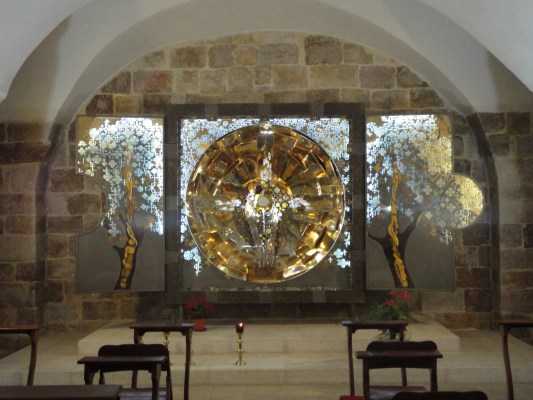
In the crypt was one of the most stunning adoration chapels I have ever seen. I took a picture, though I imagine I likely was not supposed to (I do not think God minds). It still takes my breath away, and when I think about adoration it is always the image that springs to mind. There was something powerful about the juxtaposition of the architecture of the crypt with the modernity of the tabernacle/monstrance, enhanced by the lighting and the way the piece draws your eyes to the center. There, Mary is holding Jesus, the consecrated host.
At the time, I found the ecumenical imagery of the trees with various Christian crosses on them designating various Christian churches inspiring. It is a powerful ecclesiological statement: together we all make up the Body of Christ. This statement is furthered by the fact that the crosses are lit, and the light they produce shines against the host and the gold in the piece. It serves as a reminder of the way we all are temples of the Holy Spirit. For me, the piece is saturated with Christic, eschatological, and pneumological imagery, and at the time I felt this overwhelming experience of transcendence.
Since my trip I have come back to this photo in various life circumstances, and it continues to move me, reminding me of the overwhelming presence of God I felt in that space. It has recently been an image I have felt drawn to again. So, I recently put the image up on Facebook asking for any information people might have or be able to find about the piece, and people delivered! Roger Pieper, a former classmate of mine at Saint John’s, discovered that it had been moved to the Milk Grotto in Bethlehem in 2016 and that the artist’s name is Mariusz Drapikowski. Here’s an article and a video for those who might be interested:
The artist has spoken a little about the inspiration for the piece:
This work is inspired by the Apocalypse of St. John. The closed section of the [tabernacle] represents Jerusalem on Earth, with the 12 apostles and the 12 tribes of Israel. Christ is at the center. The doors open after passing through Him and the light that represents the heavenly Jerusalem appears. … Jesus is the key of Jerusalem. Inside, two olive trees are depicted as the two witnesses of the Apocalypse. Many branches grow from these trees…the branches are decorated with many different crosses, to suggest how from a single trunk many different Christian [churches] may arise.
While I personally prefer the juxtaposition of the crypt with this piece, I am glad that it is in a place that is apparently easier for the community to arrange adoration. The apocalyptic inspiration also affirms the eschatological undertones I felt.
My reason for sharing the image is three-fold. First, I think the piece is stunning and uses modern artistry to convey the transcendence and imminence of our Lord in a way that is clear to the faithful. As a result, it can be a helpful source of inspiration when ministers think about the celebration of Eucharistic adoration in their churches. While not every church can have this piece, we can reflect on what it teaches us about adoration and how that should inform our practices.
Second, it serves as an example, for me, of the power of the Eucharist in our lives. In that moment, and when I go back to look at the image I took, I feel the transformative effects of the Eucharist in my own life.
Finally, the eschatological, ecclesiological, and pneumatological undercurrents of the piece continue to overwhelm me. As we enter the period of the liturgical year between Christ’s ascension and the coming of the Holy Spirit at Pentecost, it seems like a particularly poignant reminder of our faith.
So how am I experiencing this piece today?
Today I feel drawn past the lights and the gold to the center of the piece, to the image of Our Lady holding in her hands our Redeemer, the Son of God, her heart and her joy. What a powerful statement about the incarnation of Christ in the Eucharist and ultimately our belief in the real presence of Christ. But also what a humbling image when placed at the fourth station on the Via Dolorosa, where I experienced it. There we commemorate Christ meeting his mother, Our Lady of Sorrows, on the way to Golgotha where he was crucified. In that moment, we encounter a mother grieving the sufferings of her son and confronting her own sufferings as well. It is here that I think of the fourth sorrow of the Rosary of the Seven Sorrows:
Luke 23:27-29 – A large crowd of people followed Jesus, including many women who mourned and lamented him. Jesus turned to them and said, “Daughters of Jerusalem, do not weep for me; weep instead for yourselves and for your children, for indeed, the days are coming when people will say, ‘Blessed are the barren, the wombs that never bore and the breasts that never nursed.’
Prayer – Beloved Mother, so stricken with grief, help us to bear our own suffering with courage and love so that we may relieve your Sorrowful Heart and that of Jesus. In doing so, may we give glory to God Who gave you and Jesus to humanity. As you suffered, teach us to suffer silently and patiently. Grant unto us the grace of loving God in everything. O Mother of Sorrows, most afflicted of all mothers, have mercy on the sinners of the whole world.
A beautiful message for those who are suffering, though I would say we need not suffer silently!
While the piece articulates the transcendental joy of the risen and glorified Lord, it also reminds us of the humanity of Jesus and the presence of the Lord and his Holy Spirit among us. We go through the cross to experience the joy of the resurrection, but we never forget the sufferings of Christ on the cross. Throughout our lives, we are called to unite our own sufferings with those of Christ. At times we are with Christ on the cross. Other times we at the foot of the cross experiencing suffering like Our Lady of Sorrows. But no matter the sufferings we encounter, the Lord is with us in the Eucharist, in our hearts, in one another. The piece reminds us that no matter where we are in life, Christ is with us, reaching out to comfort us. He has sent his Holy Spirit to dwell within us, to make us part of his own heart. All we need is the faith of Mary and to say in the stillness and pain within our hearts: “Lord Jesus, Crucified and Risen Lord, send me your Spirit.”