
Headlines in the Catholic media have recently focused on a series of scandals related to Fr. Marko Rupnik. Rupnik is perhaps the most famous living artist who specializes in the decoration of Catholic churches. Since 1995 he has been the director of the Spiritual Arts division of the Aletti Center attached to the Pontifical Oriental Institute. Rupnik has become synonymous with their style of iconography and mosaics in particular. These iconographical projects of massive dimensions were made famous by their 1999 commission to decorate the Redemptoris Mater Chapel in the Vatican’s Apostolic Palace. Since then, they have installed mosaics in the Basilicas of Fatima, San Giovanni Rotondo, Lourdes and are currently being installed in the Brazilian national shrine of Aparecida. Along with these many other churches have commissioned mosaics from them (their website lists 219 churches that they have decorated).
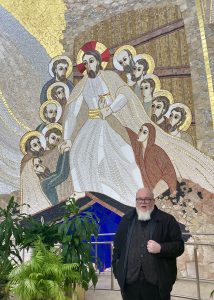
Photograph of me in the Chapel of Sacred Heart University, Fairfield, CT
Personally, I have been impressed by the works of the Aletti Center that I have seen, particularly in the Irish College in Rome and in Sacred Heart University in Fairfield, CT. And for those who have not seen any of these mosaics in person, I must point out that they don’t always photograph well and are much more impressive in person, than in their photographs.
Pauline Books and Media have stopped selling the three books that they published by Rupnik. However, what happens to the churches that he worked on is much more complicated. The question is whether churches with commissions from the Aletti Center ought to do something to acknowledge the scandals that have come to light about Rupnik? It is not as if the mosaics can be whitewashed over or the churches locked up until the case is resolved. These artworks are far from inexpensive and I am sure that many churches that installed them are still paying for them and can ill afford to replace them.
This is not the first time that a public and serious sinner has had their art in a church. Caravaggio is reputed to have murdered someone in a duel, yet I have never heard anyone having problems with his art being in famous churches. I am sure that the readers and commentators will be able to point out many other artists who lived scandalous lives, even while their work graced many churches. Indeed, the beauty of the art seems sometimes to be almost in inverse proportion to the goodness of the artist’s life. This afternoon I was looking again at the photographs that I took at Sacred Heart in CT and I still think that the art is impressive. I am sure that the majority of people who enter that church will have no idea of the scandals currently swirling around Rupnik. Yet what is the best way forward? How do we balance the beauty of the art with the need to atone for the artists’ sins? How do we publicly acknowledge the newly problematic nature of the art without fanning the flames of scandal?
Please leave a reply.