
In the late 1980s, I encountered the term “monoeucharistitis” in a presentation at the University of Notre Dame by (the now Rev. Dr.) Patrick Malloy. The term was new to me, but seemed quite apt for the phenomenon—disease, if you will—that it diagnosed.
It described the tendency for Roman Catholic parishes to use the Sunday eucharist, especially the time intended for the homily, to present a variety of information sessions about the annual budget, the bishop’s appeal, recruitment of students for religious education and/or the parish school, and so on. All of these are worthy things, but are not intended for the Sunday Eucharist and the time meant to encounter and reflect on the Word of God.
What seemed to drive this was a pragmatic realization that the assembly at Mass was, by and large, a captive audience, an audience that would not be reached to the same extent by any other means, be it the Sunday bulletin, a newsletter, the parish council meeting, or what have you. I know I write from the luxurious viewpoint of someone who has never been responsible for the running of a parish and its programs, but my point here is liturgical, and the point remains that the liturgy is not intended for extended infomercials of any sort, even though they may involve the Body of Christ gathered.
A second strain of the disease also developed: the misconception that the Church at the parish or diocesan level must attach a Mass to any occasion for which people gathered, even non-sacramental ones. Liturgies permitted to be celebrated apart from a eucharistic liturgy or communion (Ash Wednesday comes to mind) were viewed skeptically if celebrated according to the approved, official non-eucharistic rites of the Church. (Baptism, however, seemed—and seems—curiously resistant.)
The first generation of folks ministering in the post-conciliar were swept away by the Constitution’s description of the liturgy in article 10 as the “source and summit” of the Church’s work. So giddy were we that we pretty much skated right past article 9, which informed us that the liturgy did not exhaust the Church’s entire work. (I use “we” because I place myself in that first wave, though more toward the end of it.)
Nor did the Constitution envision “liturgy” and “Sunday eucharist” to be identical terms. perhaps this co-identification of the two was the first symptom of the monoeucharistitis to come. In the early years of the reform, there were some who warned—rightly so—that the Church’s devotional life was on the wane due to nearly-exclusive focus on the eucharist. Others advocated for the increased praying of the Liturgy of the Hours as part of what the Council envisioned as authentic celebrations of “liturgy” in the post-conciliar era. Both camps were, for the most part, ignored.

Lo
these many years later, parishes and parish life are in a much different place,
and monoeucharistitis is manifesting itself in another (though not entirely new)
manner. In the current demographic crisis, especially among young Roman
Catholics in the U.S., there’s something of a re-emergence of the belief that
if we perform the right kind of razzle-dazzle in the sanctuary or bring in the right
celebrity Good Catholic Personality to Mass, all will be set aright. (Musicians
are familiar with this phenomenon; we are roughly on our fourth generation of
the <insert style> music that will bring young people back to Mass.)
This is occurring within the larger framework of a new phenomenon for U.S. Christians:
the choice being made by an increasing number of people to participate in or
observe NO religious traditions/practices. As is well-known by now, the
second-largest and fastest-growing “denomination” in the U.S. is the church of
“none” (and/or “done”). Usually the research shows that matters of liturgy/worship
are really not at the heart of the ongoing decline of the place of Christianity
in western societies. I realize this is difficult for those of use whose lives
largely revolve around liturgy. Also new:
U.S. Millennial Christians have an average of four non-Christian friends, more
than previous generations.
In my view, this strain of monoeucharistitis only heaps one disease on top of another. By a wide margin, young Roman Catholics in the U.S. name the Church’s teachings/policies on matters of gender, sexuality, and marriage (same-gender marriage equality in particular) as their number one reason for disenfranchisement. Others list the sexual abuse crisis, the cover-up of criminal activities committed by clergy and others, and various acts of exclusion, discrimination, and intolerance—if not outright violence. Believing that some sort of one-hundred-eighty-degree liturgical turn in any direction will alter the reaction to institutional matters is delusional. Perhaps this is a side-effect of the disease.
All of this is NOT, I’ll emphasize, meant to advocate poor liturgical practice. If anything, during a time of crisis we need to bring our best—consistently—so that the liturgy will truly be the font of strength and summit of inspiration to carry on the work of discipleship, of following Christ. But at the same time there needs to be a very clear-eyed understanding about what the liturgy does/doesn’t or can/can’t accomplish. There is much heavy outside-the-liturgy work to be done, and if it doesn’t get accomplished, the blame should not be placed at the feet of chant or rock ‘n’ roll, or principles for translating Latin prayers. These—and others—are important matters within our liturgical life, but addressing them does nothing to address the systemic problems we face in our ecclesial existence outside the liturgy.
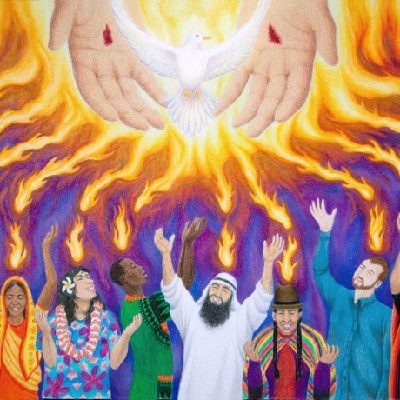
The times we live in provide us with an opportunity to keep the Eucharistic liturgy in its central and crucial role for our lives of faith, while we explore other liturgical prayers and devotions, other times to gather, other community dynamics to participate in, and other expressions that the Church has given us to come together in prayer. The wind of the Holy Spirit is facing some very strong headwinds these days, so She must continue to blow steadily through our prayer. Let that Spirit—the very breath of Christ—continue to breathe in new and healthy ways through us.
Please leave a reply.