
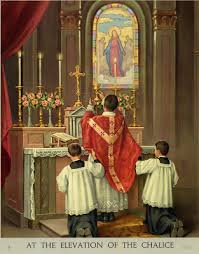
Why I Want “Cup” and You Want “Chalice”

“Marginal movements attract marginal people,” Michael Brendan Dougherty observes in a National Review piece.

He’s doing political commentary about why libertarians sometimes became fascists. But to get there, Dougherty talks about his experience with the pre-Vatican II Latin liturgy. He recounts what it was like for him back in 2002 when the unreformed Mass was a pretty socially unacceptable thing, but he was drawn to it. Dougherty had to decide whether to put up with “the people for whom the Latin Mass was just the first or the latest in a long line of disreputable fascinations and commitments.”

Dougherty jumped in and joined the TLM (Traditional Latin Mass) movement with gusto. And ever since Benedict mainstreamed the TLM in 2007, according to Doughtery, “the ratio of normal people to kooks has changed dramatically in favor of normal people.” I think Dougherty is saying that the kooks are still there – but now that that the TLM is more socially acceptable, more normal people are comfortable associating with it.

Dougherty’s point is that we make our intellectual commitments and construct our theological arguments for very emotional and social reasons. As much as we may think we’re rational and objective, we are actually making decisions about what group we want to identify with. Do I want to be one of them?

Dougherty puts it well:

“People don’t just think themselves into their ideas; they feel their way to them emotionally, and they are socialized into them. Adopting a big new idea can be like adopting a new wardrobe; it can signify and propel a change in persona.”

Which brings us to “cup” or “chalice.”
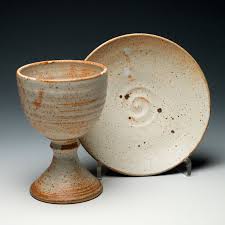
We’ve all heard ad nauseam all the arguments on every side of this issue. The Greek poterion means blah blah blah; the nature of ritual language is etc.etc.etc.; people don’t speak in normal life of yada yada yada; the liturgy is sacred because on and on and on.

Fine. Those arguments are important. It’s fides et ratio. Faith and reason go together. Rational argumentation has its place in attempting to penetrate into the mysteries of the faith.

But we probably deceive ourselves if we think we favor “cup” or “chalice” because of the strength of any of the usual arguments. In large part, we’re deciding which group we want to hang with. Or defending the commitment we’ve already made to some group or the other.

Like this:

  • All the late middle-aged liturgists and musicians I talk to think the new Missal is bad, and that Pope Benedict insulted us by tearing down so much of what we have accomplished the last three decades or so. My generation had it right, and loyalty to them demands I speak up for “cup.”
  • Some of the other seminarians I respect are pro-“chalice” (and pro-Benedict and pro-Latin Mass) and I think I want to be one of them. I’m in class with them, we play soccer together, we dream about remaking the church, and it’s exciting to be part of this group’s cause.
  • I’m in academia – maybe up for tenure, maybe hoping to land a teaching position – and the academic guild will not respect me if I break with them on the “chalice”/”cup” issue. I pen journal articles, and write Pray Tell posts, accordingly.
  • I’m an undergrad or grad theology major, and my theo friends are all over the map. We talk a lot about theology in the hallway and over beer, and when something like “chalice”/”cup” comes up, sparks fly. As I look around, this clique seems kinda weird but that group seems kinda lame, and I think I want to associate with…

If Dougherty is right about group association – and I think he is – there are important implications for the cause of liturgical renewal after the Second Vatican Council. (And on the Second Vatican Council, of course, Dougherty and I part company.)

Rational argumentation has its place, but it probably won’t carry the day. Those of us passionate about the liturgy have to be the kind of people that seminarians and young Catholics and church leaders can readily identify with.

Although the forces resisting the Second Vatican Council’s liturgy have to be countered by direct argumentation (which is not that difficult on the merits of the arguments), the long-term strategy has to be to use the power of attraction to bring those people and their passion into the fold of the reformed liturgy. It may take a few decades, but we must hope that most of them can be brought in. Then, the outright, blatant resistance to the Church’s teachings on liturgy will be marginalized. To apply Dougherty’s terminology to my worldview: the unreformed liturgy has to become the realm again of the kooks, with little power of attraction for the normal people.

I hesitate mightily to call anyone a kook, but in this case I’m going with the word usage of an insider like Dougherty. Let me put it this way: if too many of the people drawn to the TLM are normal, then we have a problem. And to any TLM-worshiper reading this, please assume that I think you’re one of those normal people! But here’s my point, to state it as honestly as possible: I’d rather have you either attracted to the reformed liturgy or else marginalized.
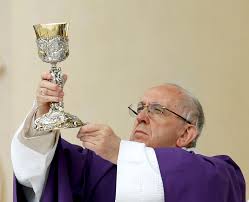
Pope Francis is all about this two-fold work of attraction and marginalization. He is laboring mightily to bring as many as possible back to the Second Vatican Council, while reducing the legitimacy of the resisters.

OK, Pray Tell readers, let’s get on it with Francis. Let’s be the kind of people who make the reformed liturgy attractive to traditionalists and conservatives and young idealists and seminarians and everyone else.

Let’s be the kind of people who are clear that the reformed liturgy has plenty of room for reverence, Latin chant, Catholic identity, beauty, transcendance.

Let’s be the kind of people who see no dissonance between all that and our commitments to community, inclusion, social justice, and engagement of contemporary culture.

As to whether it should be “cup” or “chalice,” I could go either way. But as to the reformed liturgy becoming the spacious, inclusive home for all Catholics: that’s the group I want to hang with.

awr


Anthony Ruff, OSB

Fr. Anthony Ruff, OSB, is a monk of St. John's Abbey. He teaches liturgy, liturgical music, and Gregorian chant at St. John's University School of Theology-Seminary. He is widely published and frequently presents across the country on liturgy and music. He is the author of Sacred Music and Liturgical Reform: Treasures and Transformations, and of Responsorial Psalms for Weekday Mass: Advent, Christmas, Lent, Easter. He does priestly ministry at the neighboring community of Benedictine sisters in St. Joseph.

Please leave a reply.

Comments

25 responses to “Why I Want “Cup” and You Want “Chalice””

  1. Doc Ortman

    Father Anthony, Amen! and Amen again. When announcing the joint canonization of Saint John XXIII and Saint John Paul II, Father Francis invited everyone to ponder that there is room for everyone in this household. In my experience there are many more of a more traditional bent who deny that possibility. It is not so much about the archaic language and ritual actions as much as the frightening theology and ecclesiology that lead me to pray all the harder for those who us who rejoice that Good Pope John XXIII was not afraid of the Holy Spirit.

  2. Karl Liam Saur

    Yes, shibboleths. Strain against them.

    Hard.

  3. Lee Fratantuono

    I would have little to no problem with your reflections and wishes, Father, if there weren’t the persistent implication…and outright statement…that the Benedictine decision to liberalize the 1962 Missal was somehow at odds with Vatican II (not to mention the John Paul decisions in the same matter). This narrative of Paul VI + Vatican II—rupture—big rupture—Francis + return to Vatican II…strikes me as cartoonish in its caricature. Almost as bad as the similar story in some circles of “progressive” moral theology that Francis is somehow “merciful” and his two predecessors less so.

    Benedict certainly didn’t frame his liturgical decisions as being at variance with Vatican II. He’s a serious theologian, who was at Vatican II, indeed the last pope from that era. He’s arguably one of the greatest intellects of the Church’s modern era. And yes, I know the liturgical establishment sometimes likes to claim that he is no liturgist. That argument has always struck me as the epitome of condescension.

    If you desire that “normal” people interested in the 1962 Missal be drawn to the 2002 Missal, a start might be complete abandonment of the tired binary opposition of the faithful to Vatican II and the unfaithful. Benedict wrote eloquently about how his permissions reflected sound Vatican II principles. Surely we can move forward to a more peaceful liturgical future with a little more respect for his profound observations.

    1. Anthony Ruff, OSB Avatar
      Anthony Ruff, OSB

      We disagree on this point, Lee. I believe Summorum Pontificum is at odds with Vatican II. It’s a shame it happened – it makes it that much harder for all Benedict’s excellent liturgical insights to be applied to the reformed liturgy and bear fruit there.

      awr

    2. Paul R. Schwankl

      The issue is whether “Summorum Pontificum” violates “Sacrosanctum Concilium,” not whether Pope Benedict thought it did. Even someone of his ability and dedication can be wrong. And an act of disobedience to a church council is a big deal.

      1. Fr. Anthony Forte

        Your comment assumes that it must be either/or. The Church has always had multiple rites. Why, then, is the historic Roman Rite now so unacceptable as an option? Of course, as I have pointed out before, this would not be an issue if those in authority to implement the new Mass were not disobedient to that Mass itself and suppress those options which allow for a traditional form of the new Mass.

        Additionally, you assume that the Supreme Pontiff has lost his authority to regulate the liturgy with the promulgation of Sacrosanctum concilium. SC was a snapshot in time of the prudential judgment of the council fathers on questions of the liturgy. It was not a doctrinal statement that binds all future pontiffs. The popes still remain the supreme legislators maintaining their full authority.

  4. Rita Ferrone

    I find it really offensive to hear you dismiss rational arguments and claim you know why people “really” think what they do, and it’s all about social psychology. How patronizing. Take people seriously. Do not dismiss what they think as though you know better than they do. Blah blah blah? An ounce of honest disagreement is worth a pound of psychologization.

    Plus, for what it is worth I think it’s a poor use of the example of Francis to claim what you are claiming here. He never patronizes those with whom he disagrees by assigning them inferior motives. He honors their actual motives and either agrees or disagrees.

    1. Anthony Ruff, OSB Avatar
      Anthony Ruff, OSB

      Rita, my post doesn’t “dismiss” rational arguments and say it’s “all” about social psychology – please read it again.

      I tried to say, however inadequately, that it’s both. I suppose I emphasized the social side so much here because I think all of us – me included! – tend to stay in the safe zone of our air-tight arguments and not be aware of the social aspects of our convictions.

      I don’t claim that wanting to belong to a group is an inferior motive. It’s just a motive. In fact, a very strong motive. We do well to realize that.

      I thought of including in my post extended treatment of the following piece, but decided against it. Maybe I should have. It has influenced my thinking. It is this: http://www.meltingasphalt.com/crony-beliefs/

      I teach undergrad and grad theology students. Positions that are patently obvious to me sometimes don’t have traction with some of them. I increasingly wonder why. I increasingly think that we should attend to why this is – if we are to advance our vision of renewed liturgical practice with any credibility or success.

      awr

      1. Rita Ferrone

        “We probably deceive ourselves” etc sounds psychologizing and dismissive to me. Of all the people who disagreed with you in the earlier thread I can think of no one who did so because they did not want to “hang out” with you. None of us is up for tenure and a number are not even in academe. Speaking for myself and at least those I know personally from that discussion who disagreed with you, no one gives a damn about this as a token of belonging. It’s about believing certain things are true and others false, on the merits of the arguments.

        This does not mean there do not exist some people who borrow their opinions from those whose company they keep. But the answer to that immature position is to encourage the development of a capacity for principled evaluation of the weight of arguments. As an educator, you might think that’s a primary goal. One may go along with things for the wrong reasons, after all, and that’s worse than honestly disagreeing. Or so I believe.

    2. Paul R. Schwankl

      I wasn’t terribly offended by Father Anthony’s post, because I assumed that when he said “We probably deceive ourselves” he couldn’t have been including me.

  5. Jack Wayne

    In practice, how would you go about making the liturgical reform attractive to traditionalists? I ask because this blog is generally against “reform of the reform” liturgy, which is primarily about imbuing the Ordinary Form of the Mass with “reverence, Latin chant, Catholic identity, beauty, transcendence,” as well as against traditionally styled (and laid out) buildings, art, and vestments – not to mention ad orientem, sung liturgy*, and communion kneeling. I would say the single biggest reason for SP was because these things were strongly discouraged at the OF in the 70s-90s.

    *I think you are likely for sung liturgy, but most of the non-traditionalist commentators here are not based on the reaction I have often gotten to lamenting that no one sings the credo or dialogues at the OF.

    1. Anthony Ruff, OSB Avatar
      Anthony Ruff, OSB

      Hi Jack – I’m not against any of those things in the reformed liturgy! I support and encourage all of them, both in the classroom and in abbey liturgy.

      In fact, I regret that the ROTR (which has always been unclear about whether it wants better celebration of the OF or massive structural revision of the OF or widespread return to the EF) has, since it became an organized force, made it difficult to advocate for those things. I think Summorum has made it infinitely more difficult.

      awr

      1. Jack Wayne

        I think if you asked different people who consider themselves ROTR, you would get answers all over the spectrum, though in recent years the biggest internet mouthpieces of the movement seem to favor revision of the OF as the ultimate goal (but fidelity to the current rubrics until such a time). I think you are unusual in that most people I have personally encountered who like “high” or “traditional” liturgy tend to be very warm towards the EF even if they don’t personally prefer it to the OF. Conversely, a more traditional OF is always going to attract people who would rather have the EF because it is “the next best thing.”

        I think if the ROTR and SP have made it more difficult to advocate for a traditionally styled OF, it is because those of a more “pro-Vatican II reform” mindset did a bad job advocating for and claiming those things for the last 50 years. In my neck of the woods, a Latin OF celebrated ad orientem was practically outlawed until Pope Benedict, and if you talk to older members of the tiny number of churches that continued to retain traditional aspects in their OF Masses, it is clear they had to fight tooth and nail. It seems to me that the pro-reform camp could have had all the music and traditions but instead said “we don’t want it, you can have it” and gave it away.

        If the goal is to make the OF more appealing to traditionalists as a way to eventually phase out SP, then you will need to think of a way to make it easier to do a traditional OF Mass. One of the biggest draws of the EF for many is its ease of use. A music director might have to spend years just to advocate for a a little Latin in the ordinary of the OF (only to have all that work brushed away by an unsympathetic priest), but it is a given in the EF. At the EF there might be debates about whether or not the propers should be chanted according to Rossini or from the Liber, but there isn’t a debate about whether or not propers should be used at all.

  6. Charles Jordan

    View from the Pew
    Regarding: “Let’s be the kind of people who are clear that the reformed liturgy has plenty of room for reverence, Latin chant, Catholic identity, beauty, transcendance.”
    – As children my siblings and I used Welch’s grape jelly jars as tumblers during meals.
    – Thanks to catholic grammar school we were well versed on the Sacrifice of the Mass and the necessary furnishings and accouterments to accomplish this sacred event.
    – Soooo, as children do, we started referring to the tumblers as ‘chalices’, and sometimes as ‘grails’ (we read Arthurian stories). Also, from time to time, we opined that Holy Communion would be improved were oreos actually made to be Jesus.
    – No doubt after the first 4 children my parents knew to let us chat on about these things thereby letting the truth of these matters integrate into our being and view.
    – The truth being: regardless of the nature of the vessel, it is the content within the bowl that matters, be it water, milk, lemonade, or a little wine for an high holy day feast. The mystery / joy / delight is not in the container, but in the contents. So, the tumbler which is a chalice is still a cup and a cup does contain that which is necessary and holy.

  7. Jim Pauwels

    “But we probably deceive ourselves if we think we favor “cup” or “chalice” because of the strength of any of the usual arguments. In large part, we’re deciding which group we want to hang with. Or defending the commitment we’ve already made to some group or the other”

    I think Jonathan Haidt would agree with you. Here is one of his insights:

    “People bind themselves into political teams that share moral narratives. Once they accept a particular narrative, they become blind to alternative moral worlds”

    https://www.goodreads.com/work/quotes/16252969-the-righteous-mind-why-good-people-are-divided-by-politics-and-religion

    I’d note, though, that Haidt has this to say, too – not about liturgy or liturgical governance, but perhaps the thought is applicable to those realms as well:

    “We should not expect individuals to produce good, open-minded, truth-seeking reasoning, particularly when self-interest or reputational concerns are in play. But if you put individuals together in the right way, such that some individuals can use their reasoning powers to disconfirm the claims of others, and all individuals feel some common bond or shared fate that allows them to interact civilly, you can create a group that ends up producing good reasoning as an emergent property of the social system. This is why it’s so important to have intellectual and ideological diversity within any group or institution whose goal is to find truth (such as an intelligence agency or a community of scientists) or to produce good public policy (such as a legislature or advisory board).”

  8. Berthold Kress

    Maybe it would be helpful to start talking to people who regularly attend old-rite Masses and to ask them what motivates them to do so (which in many cases still means much much longer ways), and if there is any form of Novus Ordo they might prefer, if it were available.

  9. Anthony Ruff, OSB Avatar
    Anthony Ruff, OSB

    Berthold, Rita,
    Berthold, I’m all in favor of asking people who attend old-rite why they do. But the point of my post (and Dougherty and Simler – link above, and Haidt – link above) is that all of us are susceptible to social dynamics more than we realize. Our rational arguments don’t have the weight we think, because they are only part of our reasons for believing/acting.

    Rita, I appreciate your strong response and hope it stimulates hard thought and moves the argument forward! I think rational arguments for “cup,” 1998 translation, and many progressive liturgical positions are legitimate and compelling and should be engaged on their merits. I’m sorry if I gave the contrary impression. I certainly do not believe that people believe ‘progressive’ positions only for social/emotional reasons!

    My post was meant as an invitation for all sides to explore whether, beneath rational argumentation, there are not unacknowledged social factors at play. I believe we increase the proportion of our rationality by being aware of and dealing with our social biases. I also think that progressives have better rational arguments and are less tainted by blatant social biases than traddies – which shows my biases, and my allergy to fundamentalism which is, despite its appearance, more an emotional/social than an intellectual problem.

    An example: I hate the new tendency to capitalize He/Him referring to God. I have my reasons – aesthetic, theological, linguistic – and stand by them. But if I have too much emotional baggage around it, am irrationally fearful of the dangers of it, then something’s going on I should look at. I’m probably doing at least a bit of “allegiance to Michel/Diekmann/Kacmarcik/Breuer/” aesthetic. Those very deep loyalties are probably hurting my ability to present my case, and perhaps explain why those without my prior commitment aren’t persuaded by my arguments. I’m inviting progressives to do more of that sort of introspection, and I didn’t mean this to be an offensive suggestion.
    awr

    1. Peter Haydon

      Quite right Father. It is important to try to read and understand differing perspectives. We do tend to look for the approval of our friends.
      I am sure that you are right that silly ways of offering the OF have encouraged many to prefer the EF. I suspect that the 15 minute pre-conciliar Mass did much to encourage reformers.
      I suspect also that when Pope Benedict asked for mutual enrichment he had in mind trying to get the best of both forms of the Mass.
      As an aside I agree that the less capitalisation the better. Is the intention to give the word a different meaning?

  10. Karl Liam Saur

    “Those very deep loyalties are probably hurting my ability to present my case, and perhaps explain why those without my prior commitment aren’t persuaded by my arguments. I’m inviting progressives to do more of that sort of introspection, and I didn’t mean this to be an offensive suggestion.”

    Precisely.

    If one’s goal is to persuade the as-yet unpersuaded, this is always necessarily part of preparing an argument. It’s one reason a classic method of preparation it to be prepared to argued the opposition case with its most persuasive arguments. Which necessarily means confronting unspoken assumptions, which are in a sense pre-logical.

  11. Much of the discussion here and on Anthony’s precious post on “cup” vs. “chalice” seems to be missing an important point. It seems to me that isn’t so much a matter of “who I hang out with” as, far too often, one of “what I hold more sacred”. In a lecture given at the colloquium of the Institut Supérieur de Liturgie in 2008 on the theme of “Liturgie and sacralité”, Joris Gelhof affirmed that “sacred” was a legitimate category in Christian discourse, while also warning against seeing degrees in sacredness; something is sacred, or it isn’t, period. He even went so far as to say that seeing some things as more sacred than others was dangerous. In his more recent talk at the Sacra Liturgia meeting in London last year, he said more or less the same thing. What he meant was that we should avoid claiming that “my” sacred is more sacred than “your” sacred. This misuse of the category of sacred is what lies behind much of the chalice-cup dispute. Some hold chalice to be more “sacred” because it is somehow more elevated, foreign to everyday speech, and so better suited to conveying divine reality, while cup drags us down to the level of the banal cup of coffee. But those who defend cup because of its very ordinariness also do so because they hold it to be more sacred. They just have a different idea of what makes something sacred: something that serves as an epiphany of the divine in the ordinariness of the everyday. Both sides are convinced that “their” sacred is better. Both positions have a certain merit, but they are fundamentally irreconcilable. So we don’t need more discussion of what is “more sacred”, whatever terms are adopted to mask the real sense of the argument. We need to discover the meaning of the words used and how that meaning can be conveyed in English as it is used today.

  12. Anthony Ruff, OSB Avatar
    Anthony Ruff, OSB

    Fr. Forte writes: “The Church has always had multiple rites. Why, then, is the historic Roman Rite now so unacceptable as an option?”

    Because an ecumenical council taught that it is “unacceptable,” needs to be replaced and reformed, that the liturgy needs to be reformed so as to reflect more perfectly the nature of the church. And note, SC is tied in with every single document of V2 – they all hang together. This is something more, I think, than a prudential judgment about how to change ceremonies. No new doctrine, it is true, but in a sense it puts all doctrine in a new light and reforms every aspect of Catholicism such that it is exceedingly difficult to imagine the entire thing being undone.

    And what would you go back to? Pius X and Pius XII, who each instituted massive liturgical reforms (‘ruptures,’ to be clear) and can only be understood (and are understood by the Catholic Church) to be predecessors of V2 and initiators of processes which they did not bring to completion?

    Multiplicity of rites historically has little or nothing to do with co-existence of the rite as reformed by the Council and the rite which the council declared superseded. No precedent for this. The historical precedents are all of regional liturgical traditions which grew up alongside each other and gradually took on different forms. I know of no precedent for a bishop being able to celebrate an older form of his own liturgy intact, after his diocese has already adopted a revised form of the older rite.

    awr

    1. Fr. Anthony Forte

      Reformed, yes; replaced, no. But that reform, with all obedience to Vatican II, need not have been so radical. With the exception of an expanded lectionary, all the reforms that the council called for could have been satisfied by those of 1965. You are assuming the conclusion by insisting that the reforms called for by the council equal the present post-Novus Ordo Mass as it is currently celebrated. And unless you are to hold that the Novus Ordo, which contains options for a traditional form of the Mass, is itself contrary to Vatican II, then you must concede that a traditional form of the Mass is indeed compatible with the council. It is the rejections of these legitimate options that has led to the call for a return to the old Mass.

      Yes SC is tied to the other documents of Vatican II. But likewise, Vatican II is tied to all that the Church has taught and practiced before it. It is a misreading of the council to separate it from traditional understandings of the faith. To read the council in continuity with the past is not a rejection of the council. Nor is it a rejection of the council to say that the present post-conciliar manner in which the Mass is celebrated goes beyond the mandates of the council.

      Finally, given the unprecedented nature of the reform itself, it hardly a serious argument that the existence of the old and new forms of the Mass together is unprecedented. Most everything we do today in the liturgy is unprecedented.

      1. Anthony Ruff, OSB Avatar
        Anthony Ruff, OSB

        It’s all unprecedented because Vatican II is unprecedented. Read Fr. O’Malley SJ’s book on “what happened at Vatican II’ and it all falls into place. No council has ever used language in the way Vatican II did – he lays all this out. It follows that the reforms of Paul VI are entirely in the spirit (yes, the spirit!) of Vatican II.

        But I’m not going to go over all this ground yet again with you. Enough!

        Pax,
        awr

      2. Karl Liam Saur

        “With the exception of an expanded lectionary, all the reforms that the council called for could have been satisfied by those of 1965.”

        Except that such was not understood in 1965 – the preliminary reforms in 1964-67 were understood to be preliminary. The brief for the 1965 “interim missal” as the fulfillment of the Council rests on thin soil. That of course doesn’t mean all of what followed was what the Council Fathers all specifically envisioned.

        Moreover, SC called for many other liturgical/ritual reforms beyond the Ordo Missae that were not enacted by 1965, and the reformation of the Missal had to engage many of those as well.

  13. It’s been a few days, and there are a lot of comments here, but as I have been digesting Anthony’s thoughts, it occurs to me that our inclinations to think everything is governed by good rational arguments is connected to our Modern (as in the historical period) denigration of the body.

    In other words, what Anthony suggests–that both rational and social factors are in play when we settle on a position–helpfully presents a non-dualistic account of the person.

    As much as we tend to think good arguments win the day, they just often don’t. Yes, I encourage students to argue well. I give them all sorts of exercises to help them to analyze texts, to think critically and I examine their ability to do so. But where they settle on issues isn’t simply governed by their critical faculties. And I have to confront this repeatedly in the classroom.


Posted

in

, ,

by

Tags:

Discover more from Home

Subscribe now to keep reading and get access to the full archive.

Continue reading