
By Nicholas Denysenko, April 3, 2026
The Orthodox Church enters this coming weekend of Lazarus Saturday and Palm Sunday with a joyous celebration. Jesus goes to Bethany to be with Martha, Mary, and his friends, and he raises Lazarus from the dead in one of the most dramatic episodes of the Holy Scriptures. We are filled with the good news of the resurrection in our Lord’s raising of Lazarus.
The celebration continues as Jesus enters Jerusalem and is greeted by “children with the palms of victory, crying: hosanna in the highest.”
Then, on Sunday evening, the journey begins with the familiar sights and sounds of the Holy Week highlighted by a theme expressed by a hymn: the Lord goes to his voluntary passion. Jesus Christ goes willingly to be rejected and humiliated, to suffer bodily, spiritually, and mentally, to be beaten and put to death – all in order to save humankind.
This mystery is a paradox that requires a lifetime of reflection and encounter. One of the paradoxes of this mystery is the way we describe it.
Thy bridal chamber I see adorned, o My Savior.
And I have no wedding garment that I may enter in.
O giver of light, enlighten the vesture of my soul and save me.
The Church uses nuptial imagery to describe what we’re doing in Holy Week.
So when we begin this process, we need to imagine that we have been invited to a grand wedding. We recognize that we are not fit, are not suited, for this occasion, so we ask the host to clothe us appropriately.
How does God therefore prepare us to enter into this incomparable wedding banquet?
The first message is something that doesn’t make a whole lot of sense in the way that we conduct our affairs on a regular basis. It is typically unwise to do something you’re not really prepared for.
In my experience, students who haven’t prepared for class request an extension or are absent from class.
Musicians that have not rehearsed, don’t have the music memorized, or just don’t know the music drop out of a competition.
Professors who commit to presenting a paper at an academic conference and then don’t feel like doing the work when the time approaches withdraw from participation.
We have excuses. And, to be sure, the message from the New Testament parable of the wedding banquet that inspires this hymn of light is not particularly kind to the guest who attends the wedding without the proper apparel. The guest doesn’t offer an excuse, and they expel him from the wedding.
This hymn assumes that we have shown up unprepared. The bottom line is this: the Church is not ready for Holy Week.
An Uncomfortable Truth
This bottom line tells us an uncomfortable truth about our lives:
We are not prepared for Divine Liturgy on Sundays.
We are not prepared for the sacrament of confession.
We are not prepared to repent.
We always have excuses.
The difference here is that God is not expelling us from his bridal chamber. Holy Week presents us an image of God that draws from the parable of the Prodigal Son in the Gospel of St. Luke. The message is that we have shown up for his royal wedding banquet and we are woefully unprepared. And he knows that we are unprepared. And yet he invites us to participate anyway because he is going to get us ready.
The nuptial imagery here is essential. This is an intimate gathering. This is not an instance where we’re checking our phones to determine if we have been there long enough to make an appearance and can sneak out to go home, get in our sweats, and chill.
Rather, God is inviting us to be part of his most intimate wedding party for eternity. From God’s perspective, once we say we’re in, we are in. We can’t withdraw, and even if we say “I don’t want to be in this relationship any more,” God remains intimately in love with us.
Weddings are reliable occasions for storytelling. We hear family and friends of the bride and groom tell their stories as they begin a new story of life lived together.
Holy Week: Festive Storytelling
Holy Week is the ultimate Orthodox occasion of storytelling. It is as if God tells us to take a seat and listen to his story for an entire week.
The more official way of putting this is that the main feature of Holy Week is Scripture. I would go so far as to say that the hearing of the proclamation of God’s word is our primary focus of Holy Week, over and above all other forms of ritual participation.
Let’s say that you decide to go “all-in” and attend the four Bridegroom Matins services of Holy Monday through Thursday. The readings of the services will begin to tell you a rich story about God’s covenant with his people, his acts to save humankind, and how specific characters of the story fit in, or contribute to the metanarrative – the coming of Jesus Christ, his passion, death, burial, and resurrection.
Bridegroom Matins Gospels
The Gospel readings are the primary sources for the themes of the four Bridegroom Matins services.
| Sunday: Mt. 21:18-43 | Parables of the vineyard |
| Monday: Mt. 22:15-46 – 23:1-39 | Woe to the scribes and pharisees |
| Tuesday: Jn. 12:17-50 | The announcement of Jesus’ hour |
| Wednesday: Lk. 22:1-39 | Judas’ betrayal; the Mystical Supper |
The Gospel readings are initiatory, they lead the assembly into the bridal chamber. The Gospel of the caretakers of the vineyard on Sunday prefigures Jesus’ passion and death. The Monday evening Gospel of Matthean woes invites the assembly to confront the truth revealed by Jesus in his glorification on the cross. This Gospel is particularly striking because of its distinction between divine righteousness and outward, but empty performance of assigned rituals. The message is essentially an 11th hour invitation to repent, and also a warning that true repentance is not merely a matter of executing the assigned rituals, but primarily an authentic change of life. The Tuesday Gospel functions as an announcement that the time of Jesus’ glorification is at hand and also reminds participants of Jesus’ own anxieties about the cost of this hour. The final Matins Gospel performs the dual duty of introducing Judas as the story’s primary antagonist while also leading the assembly into the beginning of the great three days, what we sometimes call the Paschal Triduum.
These services also feature hymns that expand upon the themes of Holy Week and also important figures from the Holy Scriptures. On Sunday evening, we hear the Kontakion that calls us to lament our own enslavement to sin and to receive God’s liberation from this tyranny in the spirit of the righteous Joseph, son of Jacob. On Monday, we reflect on the lesson of the fig tree cursed by Jesus because of its lack of fruitfulness. We are called to use our talents for the glory of God.
The Matins of Holy Tuesday is something of a special day, especially in our time, because it brings the sinful woman who spent all of her money on the finest oil to anoint Jesus’ feet. This message is similar to the kind of uncomfortable invitation the Church gives us to confess that we ourselves are more sinful than harlots. This sinful woman’s act of anointing depicts the image of courage – she believes with all of her heart that Christ will forgive her and therefore approaches. The final hymn was composed by a 9th century woman monastic and abbess named Cassia and is known by the name “Hymn of Cassia” or “Kassiane.”
Holy Thursday
The Matins of Holy Thursday, taken on Wednesday evening, is the first time we hear about the gathering of the disciples for the supper and Judas’ betrayal. Judas is the most visible and obvious antagonist, so the hymnographers decided to really illuminate his treachery and call us to not adopt his path.
There are two major takeaways from this pattern established by the early services of Holy Week. The first is for us to see that God continues to write his story. We are not detached observers who look in from the outside and comment, casting judgment on the likes of Judas and Joseph’s brothers. When we hear, ‘woe to you, pharisees, hypocrites,’ we understand that Jesus is addressing us as much as he was the religious elites of his time and place. When we hear about the sinful woman’s buying and anointing him with oil, we understand that we are beckoned to allow the love for God to well up inside of us like a spring and to approach him without fear. Our Lord was deepening his covenant with his disciples and the people in (and even outside of) his company in these penultimate events of Holy Week. God is likewise, now as then, continuing to write his story of a covenant of love by making us his repentant disciples, citizens of his kingdom, his priests, prophets and kings, when we hear his magnificent story during the readings in his bridal chamber.
The Vespers and Divine Liturgy of Holy Thursday has a rich history. Holy Thursday has been the traditional day appointed throughout the Christian world for a number of annual liturgical rites. These include the reconciliation of penitents – especially those who have been under the penalty of excommunication – the preparation of reserved Holy Communion for the sick, and the consecration of chrism.
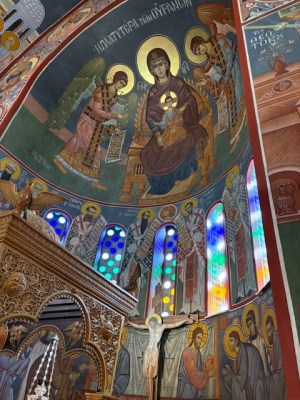
The Mystical Supper
The heart of Holy Thursday is the commemoration of the Lord’s Supper. After over one month of fasting and drawing nearer to the Lord through communion of the Presanctified Gifts, we gather for Vespers and Eucharist in commemoration of our Lord’s supper with his disciples. Most of us eat and drink two or three times a day. We sit with others and talk about our day if we are fortunate. Many of us sit alone, possibly on a device while we eat. No, it is not really plausible to make every meal a special occasion. But take a minute to think about the most wonderful special occasions you have had over a meal. It could be a wedding in your family, or a series of Thanksgivings, or the time you proposed, or even a funeral repast. I hope, for all of you, that you loved and knew that you were loved during a meal in your life.
Our Lord gathered his disciples for a special dinner to tell them and show them how much he loved them. Yes, his taking of the bread, giving thanks, and blessing it, along with the cup, have become familiar routines for us. But try to imagine that you have made the decision to devote yourself to the most important human being in history – more important than even your mom, your sibling, and your spouse. You have followed him through thick and thin and he has shared his life with you and taught you – more than anything else, how to love. And you have come to know how much he loves you because he has not given up on you, no matter how hard you fell, how distracted you have become with things that aren’t super important, how indifferent you might have felt, how discouraged you became, and how much you doubted. No matter.
You are still invited and wanted for this special dinner, and the food and drink, from the appetizers through the main course, are amazing. When the time arrives for the traditional sweet bread to be divided along with a post-supper cup of wine, he explains that his bond will be renewed, strengthened, and sustained in you every time you eat that bread and drink from that cup. The experience of being loved and wanted – and saved! – by the most important human being to ever walk this earth is so overwhelming that you can’t imagine life without coming back for that meal, over and over again, because his love for you has been so true, so real, that you have no doubt that absolutely nothing can separate you from Christ’s love – not. even. Death.
Pascha has already begun
Here is where I will beg all of you to remember this one truth. Our celebration of Pascha is not deferred to midnight on Sunday when we go outside, as wonderful as a moment as it is. Our celebration of Pascha has already started when we gather for this Holy Thursday liturgy because Pascha is not just resurrection, but also the memorial of our Lord’s passion, death, burial, his descent into Hades as well. And this meal is where he consummates his love for us by sharing all of himself with us, not just in this single moment, or even for the rest of our lifetime, but forever.
This is why the Church has shined a light on Holy Thursday as a special day for rituals that unite people to the community of the church. This is also why the strict fast of Holy Week is lifted on this day to enjoy olive oil and wine. It’s unfortunate that the sheer volume of services tend to discourage communities from having some kind of festive meal after this liturgy, because it is most appropriate for a feast hosted by God to show his people how much he loves them.
The long, composite reading drawing from the Gospels reminds us that the Supper hosted by our Lord was not an isolated event or just one detail of many. The supper was the first of many he would share with all of his disciples throughout the world – a veritable love feast that gives us the opportunity to receive the love of God and learn how to love, over and over again. The Gospel account is long and it breaks open the Old Testament lessons from Exodus, Job, and Isaiah, that speak of Israel’s requirement for ritual purification (in conformity to God’s law), a reminder of God’s almighty power, and the promise of God’s steadfast love.
We need to hear these readings.
We need to prepare ourselves. We have tethered ourselves to Jesus Christ and have devoted ourselves fully to following him. But we are about to be challenged to our core. We are going to see that those who are threatened by Christ seek to seize him and eliminate him from the picture. We will see how some of our own brothers and sisters falter when they are mocked for their devotion to him. We will see him refuse to strike down his oppressors and instead submit to the humiliation they inflict on him. We will hear how his disciples crumbled when this happened and we will be invited to see how easily we set aside our own faith, our values, our oaths and promises, when the powers of this world entice us with promises, reassure us that they are authentic Christians, and threaten our security if we do not exalt them as the kings and princes of this world. We need to prepare ourselves to endure this crucible and trust that God’s promise will be fulfilled when the ordeal is over.
We know that God is the author of the New Testament because he permits these bonds of love and communion to be strained to their core when Jesus – who had just washed his disciples’ feet and declared his eternal covenant with them, endures betrayal, arrest, interrogation, physical abuse, false accusations, and capital punishment without destroying those who bring it on them. He has revealed his new commandment of loving one’s enemy to the bitter end and beyond and shows the world how to love the enemy – to die, at their hands, and even forgive them while he is slowly asphyxiated and nailed to the cross.
Holy and Great Friday
The services of Holy Friday continue the pattern of combining the appointed Scripture lessons, hymnography, and ritual actions to express the Church’s love for Christ. I would like to begin this penultimate section by focusing on three elements (even though there are many from which we could choose). The first is the first Gospel reading, which sets the tone for the evening. The second is the eighth reading from St. Luke, followed by the Exaposteilarion (“The Wise Thief”). The third is the two acclamations we sing before and after each Gospel, which happens for all the services of Holy Friday.
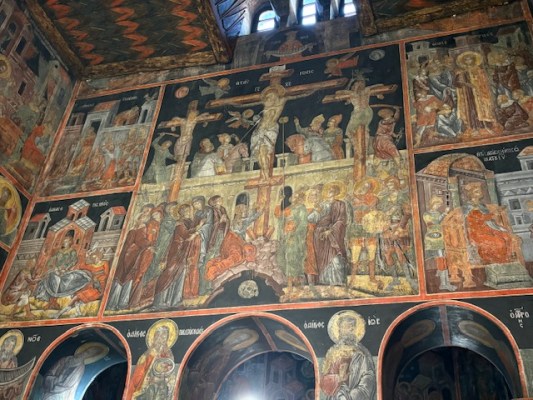
Clearly, the service itself centers on the Gospel accounts. The first Gospel from St. John does not mention the events we associate with Jesus’s death – his arrest, scourging, and crucifixion. Instead, this Gospel sets the tone for those who hear it by emphasizing Christ’s prayer to the Father for the Church and his love for the Church.
The account gets right to the point: Christ’s passion, death, burial, and resurrection are his glorification. It is glorious because of his act of love – of seeing it through to the end and granting eternal life to his disciples in spite of their doubt, weaknesses, misguided priorities. This Gospel account brings past, present, and future together and gives us something to contemplate with all of our hesitations to reconcile with enemies. Christ prays to the Father that “they would be one, as we are one.”
We need to hear this in the present tense, and not as visitors to Jerusalem over 2,000 years ago.
Christ is not just telling Peter and his disciples to love another; he is telling us. Christ gives his peace to his disciples and to us. He invites us to abide in him and in his love as much as he invited his disciples then. Now, we heard what took place after his discourse with his disciples and his prayer to the Father. They let their hearts be troubled; they did not understand that his voluntary passion would give us peace; they scattered when the religious and political authorities seized and put him to death.
We do not look back on them with admonishing judgment; we do not even condemn Judas. We bear witness to the heart of our faith – today, Christ sits at the Father’s right hand and offers this prayer for us. And our “access” to this prayer, the privilege of coming together to hear him tell of his glorification – this is his way of binding us to him in love.
After tonight, and especially after the Passion Gospels on April 9, think about the meaning of what it means for us to abide in Christ.
The Gospel account from St. Luke on the confession of faith by the thief on the cross resounds throughout the world. Throughout history, musicians have set the exaposteilarion to settings to bring forth this reality – that a common criminal who had no prior knowledge of Jesus would be given the gift of eternal life “in a single moment.” (Today, you will be with me in paradise). In the aftermath of Gethsemane, betrayal, the disciples’ scattering, and enduring mocking, spitting, and beating – our Lord, as he is dying on the cross and about to give up the spirit – promises paradise to a common thief.
What greater love is there than this, than to grant not only amnesty, but the gift of eternal life to someone who confessed his faith at the last second?
How much time do we spend lamenting the sins of others and hoping for their damnation? Becoming a hearer of God’s word demands that we bear witness. Bearing witness to our Lord’s gift of paradise to the thief on the cross means that we ask for the grace to hope and pray for the repentance of sinners even at the eleventh hour, and also receive the gift of paradise from Christ since we are no better than the thief on the cross.
Throughout the service, we sing two refrains appointed on this only (with the exception of the passia service celebrated here and there during Lent).
Glory to your passion, Lord! Glory to your longsuffering, Lord!
The passion Christ endured was wrapped up in divine love, offered to save humankind from the passions that led to our death. We do not glorify the passions of narcissistic self-aggrandizement, of nonstop virtue signaling on digital media, of the construction of empires in our name and for our glory. The only passion we glorify is the one of Christ – because this passion was offered up for us and for the life of the world.
The question of whether or not God suffers has been debated by Christians for centuries. Patripassianism – the teaching that God himself is vulnerable to suffering – is incompatible with Christian teaching. And here we stand, singing “glory to your longsuffering,” to the Incarnate God. This refrain invites us to explore the suffering that comes from love a bit more deeply.
Most of us here have loved and been loved, and we know that love – a true pouring out of one’s self for another – comes with suffering for many reasons. Love that is not returned or reciprocated. Love that is betrayed. Love that seems to fade for one of the two. Love that is rejected. Love that seems to be taken millions of miles away by the wind of death.
There is no “guarantee” that the other will receive, reciprocate, and express love. Suffering comes with love when one loves regardless of whether or not it is reciprocated. This was the love that became an offering from our Lord – a love offered to the point of his own death on the cross for those who rejected and strayed from him. What a glorious longsuffering our Lord has done for us!
The Vespers of Great and Holy Friday and the Matins of Great and Holy Saturday provide the context for the final part of my presentation today. These are obviously enormously popular services, due in large part to preparing a tomb and laying the shroud of Christ (epitaphios or plashchanitsa) on the tomb.
Holy Friday: “Good” Grief and Lamenting
I would describe the experience of Vespers as something related to the grief we experience when someone we know and love dies. No matter how many times we have fulfilled our ministry as hearers of God’s word, the news of his death, of his voluntary giving up of the spirit is still unfathomable. It’s the kind of situation where you simply cannot ignore what you have heard. There is no real way to prepare for this news.
Drawing from my own memories of the death of loved ones – in my case, my parents and also my wife – there is a sense of movement, of progression. The experience of standing before your spouse’s casket is not the same as receiving the news that “she has died.” Historically, musicians have captured the sheer weight of death and bereavement in their compositions, perhaps most poignantly by Johannes Brahms in movement no. 2 of his famous Requiem, composed to mimic the difficulty of carrying a coffin to a gravesite in the German countryside.
I always sensed the power of God during the panikhida, especially in the Evlogitaria (“Blessed are you”) and the kontakion “With the saints.” The ritual moment communicated God’s acknowledgement of our grief, our despair, our fledgling faith in the resurrection as we sing our loved ones into God’s kingdom.
So it makes sense that we feel the weight of our Lord’s death and burial at Vespers.
Look at it this way. When we stand at the graves of our loved ones, say goodbye, and then visit them at their burial sites, we are going there for one reason only – because we love them. And that is what we are doing here – we are coming forward to kiss the body of our Lord because we love him.
When we say goodbye to our loved ones, it is possible for something beautiful to happen. The petty arguments, betrayals, cross words, hurtful acts of our lives – they can begin to die, to be changed into only love.
Our standing at our Lord’s tomb is an opportunity for us to allow him to remake us, to receive his love, even as he is buried in a tomb.
This message is expressed much more poignantly in the Matins and Lamentations of Holy Saturday. Surely there is a great deal of excitement that begins to spring forth as we stand before the tomb in Lamentation. We do need to pause momentarily to consider the enormity of what God has done for us. The poetry and hymnography of the Lamentations permits us to imagine the experience of Mary, the Theotokos. Jesus’ mother stood with him through thick and thin. She became the blueprint for all of us in how we are to respond to God’s call – to say, yes, here I am, when God calls upon us. The service of Lamentations is a way of inviting us to join Mary, to ponder the things we have heard as hearers of God’s word in our hearts, and – bear with me here – to allow our souls to be pierced by a sword.
God Almighty, the creator of the universe, who gave us the privilege of living, breathing, being, loving, being loved – became human, loved all of the people he encountered, and gave his life. The author of life goes into the place ruled by our bitter enemy – Hades, where we had previously been imprisoned and separated from God by death – and fills it with his uncreated being, destroying it, and ending its reign in and over the world.
Perhaps our lamentation really has very little to do with “what those people did to Jesus.” Maybe our lamentation is to stand still before a space devoted to the one whose love was so limitless, whose desire for us was so relentless, that he went into the very place that had held us captive. Maybe we lament how easily we forget that he did this for us – for you and me – and wants to be in love with us today, and tomorrow, and for eternity.
One of the hardest lessons for Christians is to realize that we, as the “new Israel,” are no better than the old Israel. We, too, have failed, have sinned, have misguided priorities. Ezekiel’s prophecy on the dry bones is not only about the fallen kingdom of Judah, but also a judgment on us. We have no power to raise ourselves. We have every opportunity to receive the breath from the spirit of God and to rise up when he recreates us into his holy people, reforged for immortal and incorruptible life where we abide in him. These services of Holy Week end with confidence and authentic hope.
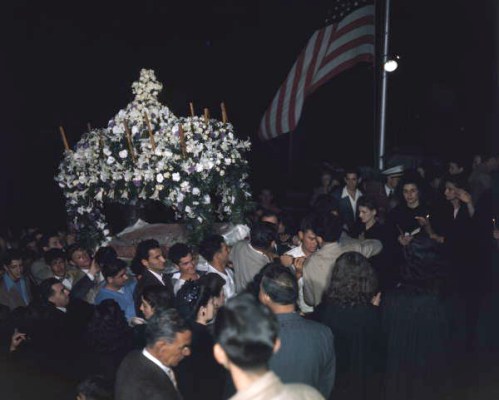
In his discussion of the history of the plashchanitsa, Taft described the Holy Saturday procession, which tends to go outdoors to the singing of the Trisagion hymn, as the “Byzantine burial procession.” The ritual we enact as we process with the plashchanitsa outdoors seems to resemble a burial procession, given the singing of Holy God and the solemnity of the moment. We need to remember, though, that the funeral procession itself is the commendation of the departed servant to God – not to eternal emptiness and isolation from God. The readings appointed for the funeral service proclaim faith in Christ’s resurrection, and also in ours.
It has become customary for us to hold the Plashchanitsa at the threshold of the church and reenter by walking underneath it. Keeping in mind that symbols and the rituals associated with them can always have more than one interpretation, let us remember that Holy Saturday is a commemoration of our Lord’s sabbath rest. Christ descended into Hades to free all of those held captive there during his rest. What greater hope can we have for our future – including the eternal one that is really our destiny after this brief sojourn here on earth – than to know that death has no power over us? Think of walking underneath that plashchanitsa as a way of seeing, in a limited fashion, Christ’s conquering of death and his transforming it into passage to life – life in him, along with the Father and the Holy Spirit. This is how the procession with the plashchanitsa could be one of both solemn contemplation on the maker of life voluntarily giving up his life and also how his death can be hailed as an eternal victory that united heaven and earth once and for all.
This service of the Matins of Holy Saturday ends with a very short Gospel. The brevity of the Gospel stands out in the midst of the enormous collection of words we have heard. Our Lord and God, the creator of all, Almighty only-begotten Son of God, is buried in a tomb, sealed by a stone, with a guard standing watch. The evening ends with a sense of tension. How will this story end?
As we prepare for Holy Week, let us prepare ourselves in this way:
- Our busy schedule of Holy Week is the outcome of a complex historical process. It is not our task to undo the process, but to appreciate the fact that traditions cultivated in Jerusalem, Palestine, and Constantinople contributed to our experience of Holy Week.
- The fact is that we all have limitations. Do what you can in Holy Week. Be present and active. Remember that God is speaking to us today, in these services. We’re neither viewing nor performing a historical reenactment – we are IN this story – with the disciples, Judas, Pilate, Mary, and our Lord himself.
- Participating in these services makes us hearers of the word of God. Think of this as sitting at the table with the people who participated in the event and hearing the story from them, at their feet, in real life, and not like putting on earbuds while listening to a narration in a museum.
- Participating in these services is deepening our communion in the Lord, in his love. We learn, over and over again, the truth about God’s love for us. He invites us to abide in him. Part of what we are doing at these services is indicating our response – will we receive this gift of love from our Lord? May it be so.
Please leave a reply.