
What counts as an office, and what doesn’t??
As a younger monk, I got bit of the old moral theology when an older monk advised me that one fulfilled the obligation to pray each office, i.e. avoided serious sin, by praying “any three psalms” if one missed an office. He had committed the three shortest psalms to memory!

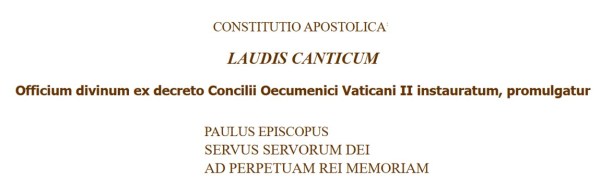
If I were to name what is most essential to the Office, I would go in a different direction. My starting point would not be specific content in the way of required texts. It would be the act of gathering with others. The Office is, above all, the daily prayer and praise of the Church gathered. As Pope Paul VI put it in his apostolic constitution on the reform of the Roman office, it is “an unmistakable sign of the praying church” and “primarily the prayer of the entire community of humankind joined to Christ himself.” And this:
“Each individual has his or her part in this prayer which is common to the one Body.”
There is something about Christianity that calls Christians to do their praying with others. There is something about the Church that it needs to gather daily as the Body of Christ. There is something about Baptism that compels one to gather liturgically with other baptized members.

My thinking on this topic is informed by the excellent book Company of Voices: Daily Prayer and the People of God by the Anglican monastic George Guiver. (I expect I’ll be referring to this book again in this series of posts.) Fr. Guiver taught me that there is an amazing variety to the shape the Office has taken in different times and places historically.
Did you know that, in the tradition of the Church, there have been forms of the Office that had little or no psalmody, or little or no reading of other parts of Scripture? And yet, the Church gathered for daily prayer and praise. That’s the constant across the centuries.
None of this is to deny the value of private and personal prayer. Sometimes one prays the office by oneself. (Even the Rule of Benedict in Chapter 50 says that a brother away from the oratory is to kneel wherever he is and do an office as best he can.) But as Fr. Guiver reminds us, the private prayer of a Christian is always done in union with and in conscious awareness of the entire Church. Private recitation of the office, while legitimate and praiseworthy, is a derivate form and something of a distortion of the ideal.
Important ecclesiological issues are at play here. This is about the relationship between Baptism on the one hand, which is foundational, and ordination and monastic profession on the other, which are, respectively, a service to the baptized and an intensification of the call to pray which is incumbent upon all the baptized to the extent they are able.
The Office is not in essence the prayer of clergy and monastics which, in trickle-down fashion, can also involve the laity. It is the prayer of the Christian community which of necessity is sometimes prayed by an individual lay person, cleric, or monastic.

Kudos to the Eastern and Oriental Orthodox and the Anglicans who have preserved this ancient, traditional understanding of the Office in their parishes. I regret that the Roman Church has not.
On to the subtitle of this post. What shall we do with the word “breviary”? Stop using it, I say. The Roman Catholic Church no longer has a breviary. The term was abolished after Vatican II. It reflects a misunderstanding of what the Office is.
By my count, the 1970 apostolic constitution Laudis canticum of Pope Paul VI, cited above, uses the term “breviary” six times. But in every case the reference is to Office books before Vatican II, never to the reformed Office currently in use.
A breviary is (ahem, was) a private prayer book for use by one person. The Office is something else – it is the Liturgy of the Hours, the daily prayer of the Church.
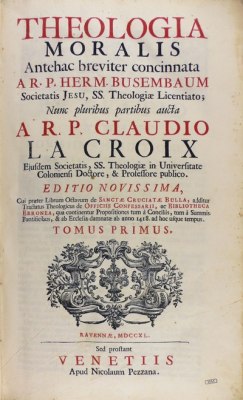
Books for the Office have a checkered history in the West. Their evolution is analogous to the books used for Mass. In both cases, originally you would have had multiple books for multiple ministries, reflecting the nature of the liturgical assembly and its varied ministerial roles. In the second millennium, these got collapsed into one volume for use by the lone cleric who played all the roles himself. Two new (and untraditional) terms emerged: the “full missal” for Mass, and the “breviary” for the Office.
Currently, for a priest celebrating a “Mass at Which Only One Minister Participates,” as the General Instruction of the Roman Missal has it, it is something of a hassle that the priest cannot read all his texts from a missal, as before Vatican II. He also has to use a separate book, a lectionary, for the Scripture readings. The inconvenience is a salutary reminder that such a Mass with only one minister is a derivative and somewhat distorted form. (When private Masses at the side altars of St. Peter’s Basilica were banned under Pope Francis in 2021, it was a significant step forward in the recovery of the Church’s liturgical tradition and the reception of the liturgical ecclesiology of the Second Vatican Council, not without significance for eventual reunion with the Orthodox, Anglicans, and others.)
It is longstanding custom in the West that parish priests pray the office privately. Many a devout priest completed his entire office for the day, including Compline, before breakfast. I respect the discipline of my brother priests. But I regret that the Roman Catholic Church has not made more progress in establishing regular communal celebration of the Office as urged in Paul VI’s apostolic constitution.
I don’t suppose we would stop publishing Office books with everything in one place, but instead make our parish priests juggle several books to pray their office – one volume with the presider’s collects, one with the lector’s readings, one with the reader’s petitions, one with the congregation’s psalter and responses, and so forth. That would be a perverse and counterproductive way to make a point.
But I regret we are not able to celebrate the offices as daily public prayer in our parishes. I recognize that it would be exceedingly difficult to do so. It is hard to imagine parishes priests, especially those pastoring several parishes, scheduling a public office in church at the same time each morning or evening, and praying the office in church whether or not anyone joins him. It is not easy to imagine a massive shift in custom and piety whereby lay people – volunteers, or parish employees – would regularly lead such services when a priest or deacon is not present.
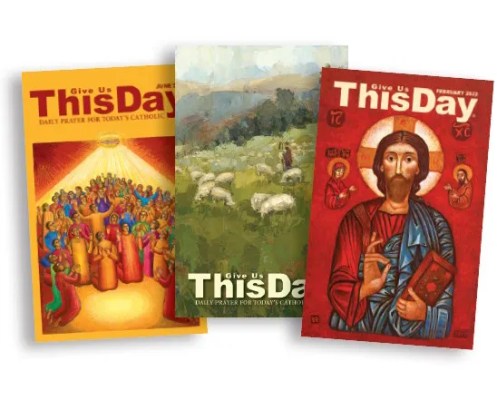
Are small steps possible? Could parish meetings take place in conjunction with a form, however abbreviated, of the Office? This might be as simple as what is in resources such as Give Us This Day.
When, for example, an evening parish council meeting begins or ends with this, could it be understood that the participating priest or deacons has thereby fulfilled his obligation, since the Office is more about gathering than about getting specific content done? Would clergy accept that it is, in a sense, more traditional and more Catholic to pray a shorter office with others than it is to pray a longer (official) office by oneself?
It’s fun to dream. And if nothing else, could we at least stop using the term “breviary”?
awr
Part 1 in this series: Reform of the Reform of the Reform
Please leave a reply.