
This post continues the Obsculta Preaching Series, sponsored by the Obsculta Preaching Initiative at Saint John’s School of Theology and Seminary. In these posts, our authors engage a variety of ways in which scripture, preaching, and liturgical worship interact with the life of the faithful.
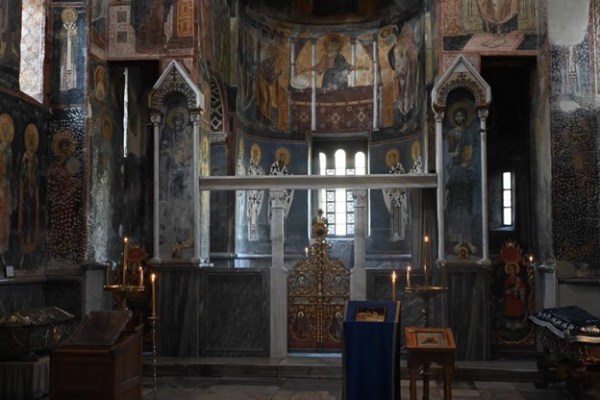
(Katholikon of Studenica Monastery Serbia, 2022 – Photo by the author)
The ritual of the Christian east is a constellation of sensory cues designed to communicate meaning to the community assembled for worship. If contemporary eastern Christianity is unique in this, it is not in kind, but in degree. So it is, when one enters a typical church, she is surrounded by shimmering gold leaf and vivid color coalescing into the forms of angelic powers, saints, Mary, Jesus Christ, in portrait and narrative. The phenomena of light and shadow, central and liminal spaces. Smell and sound envelop the worshipper. Chant and movement surround her. All this together communicates the presence of heavenly worship not at a remove, neither memorialized nor anticipated, but here and now. This multisensory marvel weaves its entrancing tapestry from opening blessing, through psalms and procession, to intoned scripture lessons, then the Gospel is replaced on the altar—
—and it comes to a screeching halt.
Father is going to say a few words.
Gone is the impressionistic, multimedia, synaesthetic communication of the sacred arts; now for something completely different. A theological lecture, perhaps? Maybe an extended Bible study? How about a moralizing exhortation touching on the day’s readings or the week’s news? Whatever the genre, all too commonly we find the homily to be, at best, a pause; at worst, an interruption of the liturgy. (In the Orthodox Christian tradition, there is no distinction between the terms sermon and homily; preacher and homilist: we use them interchangeably, and I will do so in this series.) There are technical and theoretical symptoms rising from this incongruence, many of which can benefit from the interventions of the New Homiletic. For this series, however, I would like to explore what the liturgical arts accomplish, so we may understand the root difference between them and the kind of preaching that rudely cuts them off. To do that, it is helpful to consider the theology behind sacred visual art.
Iconoclasm was initially an eastern problem. Despite early Christians’ sometimes ambivalent attitudes toward portraiture (they seem to have been almost universally fine with narrative imagery), there was no serious or systematic call for image destruction until the eighth century. At that time, John of Damascus wrote a defense of the use and veneration of images, imperial policy changed, the matter ebbed. The issue then rose again in the ninth century, and this time Theodore, abbot of the urban “Stoudion” monastery in then-Constantinople, expanded on John’s writings. Their apologetics contained a crucial argument: the image offers a real encounter with the one depicted. One way this is described is through the likeness. The likeness of the subject is impressed in the mind of the artist like a seal in wax. Every human has a likeness, and that likeness can be conveyed through an image. The image could be composed in any kind of medium, but it is the likeness within the image that is significant. The artist, in turn, impresses the seal of the likeness into the image. When someone then sees that image, it is that likeness contained in the image that bears the mind of the viewer to the prototype. Thus, for Theodore, when someone venerates an image, he is not venerating the medium but, because of the likeness in the image, he venerates the prototype. This is why he can say that he does not honor paint and wood, but Jesus Christ, whose likeness is conveyed via paint and wood.
The point of the image is encounter. This sacred art is meant not merely to instruct the faithful (pace Gregory the Great), but it facilitates communion. This is true of all the liturgical arts—they are all forming an encompassing, diachronic and synchronic image of heavenly worship. Through that image, these arts convey the likeness of this timeless worship to the assembly who experience it as something true and participable here, now. It may not surprise us to learn that homilies preached in the premodern world that gave us this tapestry could also function iconographically, which is the subject of the next post.
Please leave a reply.