
This post continues the Obsculta Preaching Series, sponsored by the Obsculta Preaching Initiative at Saint John’s School of Theology and Seminary. In these posts, our authors engage a variety of ways in which scripture, preaching, and liturgical worship interact with the life of the faithful.
The liturgical year now draws to a close, as has the U.S. political cycle culminating in another presidential election. The key events for each—Election Day and the Feast of Christ the King—occur, respectively, early and late in this month of November. The year has, as I noted in my prior essay, been fraught with social and interpersonal tensions. Now the results, as anticipated in my first article, elicit diverse thoughts and emotions, ranging from fear to jubilation. Preaching to such assemblies on this festive celebration invites consideration of its origin and implications for lives of faith.
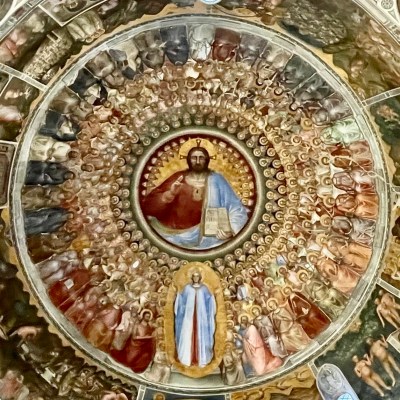
The Solemnity of Our Lord Jesus Christ, King of the Universe is a modern feast, originated by papal decree in 1925 and conceptually revised, with expanded title, in 1970.
Pope Pius XI’s Establishment of the Feast (1925)
Pope Pius XI published Quas primas, the encyclical establishing the feast, at the end of a jubilee year amidst lingering devastation from World War I, the triumph of the Russian communist revolution, and rising forces of fascism across Europe. Pius’s survey of the socio-political and ecclesial conditions necessitating a new solemnity of the Lord portrays longer modern roots, including oblique references to the post-revolutionary American and French republics:
If We ordain that the whole Catholic world shall revere Christ as King, We shall minister to the need of the present day, and at the same time provide an excellent remedy for the plague which now infects society … its errors and impious activities. This evil spirit, as you are well aware, Venerable Brethren, has not come into being in one day; it has long lurked beneath the surface. The empire of Christ over all nations was rejected. The right which the Church has from Christ himself, to teach mankind, to make laws, to govern peoples in all that pertains to their eternal salvation, that right was denied. Then gradually the religion of Christ came to be likened to false religions and to be placed ignominiously on the same level with them. It was then put under the power of the state and tolerated more or less at the whim of princes and rulers. Some men went even further, and wished to set up in the place of God’s religion a natural religion consisting in some instinctive affection of the heart. There were even some nations who thought they could dispense with God, and that their religion should consist in impiety and the neglect of God. The rebellion of individuals and states against the authority of Christ has produced deplorable consequences (no. 24).
Pius asserted that taking fuller advantage of the biblical and traditional sources ascribing to Christ “the metaphorical title of ‘King’” would strengthen the free will of men and women to live according to his truth (no. 7). The effective means for building up Christian living, he argued, are not dense treatises but, rather, the word, ritual, and artistry of liturgical celebration. Such “spiritual” formation comprises the only sure power to counter the “deplorable consequences” of the modern social state of affairs:
… the seeds of discord sown far and wide; those bitter enmities and rivalries between nations, which still hinder so much the cause of peace; that insatiable greed which is so often hidden under a pretense of public spirit and patriotism, and gives rise to so many private quarrels; a blind and immoderate selfishness, making men seek nothing but their own comfort and advantage, and measure everything by these; no peace in the home, because men have forgotten or neglect their duty; the unity and stability of the family undermined; society in a word, shaken to its foundations and on the way to ruin. We firmly hope, however, that the feast of the Kingship of Christ, which in future will be yearly observed, may hasten the return of society to our loving Savior (no. 24).
To my reading, those societal, interpersonal, and personal vices no less pervade today’s neoliberal society. Taken with the contemporary proper readings for the feast (see below), that passage may well “preach.” Still, the encyclical’s vision for the rule of Christ in people’s lives ultimately proves a restorationist one, proposing a newly “courageous” faithful who would not only “win over to their Lord those hearts that are bitter and estranged from him” but also “would valiantly defend his rights” (no. 24). In the broader scope of the text, Pius argues that Christ’s rights include governments and rulers openly subjecting themselves to him, to his reign.
Restoration and Renewal of the Feast (1970)
Such a possible hankering for Christendom, likewise implied in some of the proper prayers for the feast’s missal and hours, could not stand in the wake of the Second Vatican Council’s constitutions on the church, decree on religious freedom, and declaration on the church’s relation to non-Christian religions. The Consilium reformed the solemnity in a cosmic and eschatological direction. The liturgical commission both expanded the feast’s formal title (Our Lord Jesus Christ, King of the Universe) and revised its proper prayers. Pope Paul VI implemented the new Roman universal calendar, beginning January 1, 1970. The feast’s date moved from the Sunday before All Saints Day to the last Sunday in Ordinary Time. The liturgical year thereby ends on a cosmic-eschatological note utterly resonant with the one on which the new year will begin. The first Sunday of Advent, and then nearly two-thirds of the entire season, proclaim and respond to Christ’s anticipated, final coming in glory.
Preaching the Word on the Solemnity of Christ the King
The other key to the restoration and renewal of the Mass, namely, the liturgy of the word, affords both preacher and assembly rich fare from both testaments of the Bible. A close study of the biblical survey early in Quas primas betrays a direct correlation between the biblical texts Pius enlisted to argue for the traditional roots of the new feast and the three-year cycle of lections for the current, revised feast. It would seem the lectionary’s composers drew direct inspiration from Pius’s encyclical.
Treatment of the breadth of those Old and New Testament readings is beyond the scope of this short essay. Still, just a brief note about the gospel passage for the present Year B can point toward the type of message that might challenge or console what assemblies in U.S. parishes and chapels are open to hearing. The selection, Pilate’s second interrogation of Jesus (John 18:33b-37), ends with:
[Jesus answered], ‘But as it is, my kingdom is not here.’ So Pilate said to him, ‘Then you are a king?’ Jesus answered, ‘You say I am a king. For this I was born and for this I came into the world, to testify to the truth. Everyone who belongs to the truth listens to my voice.’
In yet another election cycle and ongoing political environment that scholarly analysts have begun to identify as a “post-truth” era, prayerful preparation for preaching might yield a homily in the prophetic vein of all three of the day’s readings (Daniel, Revelation, John). In times of assault on truth exuded in politicians’ and peoples’ words and behavior, the preacher may review the truth the assembly have heard over the preceding thirty-three weeks: Jesus’ (and others’) words and deeds in Mark’s gospel. That is the truth by which the truth himself, the coming Son of Man (Dan 7:13; Rev 1:7), judges the citizens of the universe, not least we who proclaim him its king (Rev 1:5).