

Every year since 2014, I have been looking forward to a pilgrimage to Valparaiso, Indiana. In my anticipatory excitement, I am not alone. On the second week of Easter, I and two hundred fellow travelers descend on the small college town for the Institute of Liturgical Studies’ three-day conference, an event graciously hosted by the eponymously named Valparaiso University. ILS at ‘Valpo’ – as the university is usually referred to by its student body, faculty, alumnae, and visitors – is, for liturgically minded Lutherans, the Hajj of the Midwest.
2024 was no exception. From April 9th to the 11th, we had the privilege of attending the seventy-fifth conference of the long-standing Institute. This year, the carefully curated event explored the timely theme of consumer culture and its present-day relationship with (and impact on) the liturgy of the Church.
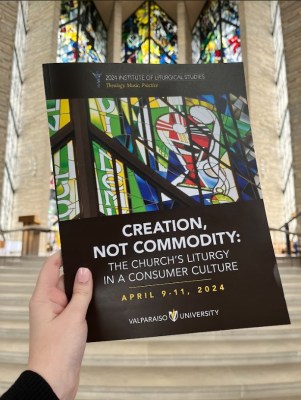
Like the flavor of the water we drink or the smell of the air we breathe, which we tend not to notice, we often take for granted the ideological spaces we inhabit and the marketplace dynamics we – consciously or unconsciously – participate in. The topic for this year’s Institute,Creation, Not Commodity: The Church’s Liturgy in a Consumer Culture, made space for acknowledging that the subtle conditioning of the market (and the habits of material consumption into which we are relentlessly enculturated) presents us with steep challenges, yet poses intriguing opportunities. The rich dialogue around this topic felt more than opportune. For me, it was urgent.
What did the conference look like? On the worship side, there were two festival eucharistic services (Gathering and Sending) and three offices (Matins, Midday, and Vespers). These services were all gracefully and imaginatively led in the incredible space that is Valpo’s Resurrection Chapel. On the learning side, we heard from three extraordinary plenary speakers. Additionally, several in-depth sessions and what felt like a veritable phalanx of practical workshops made it difficult for some of us to decide what to choose. Luckily, these offerings were divided roughly into a liturgy and preaching track on the one hand and a music and art track on the other. I am not complaining: this robust fusion of theory and praxis, this rich intellectual buffet, is what attendees have come to expect and look forward to every year.
The majority of folk who attend ILS are Lutheran in background. ILS has been, after all, deeply rooted in its Lutheran identity from the beginning. In recent years, however, the Institute has begun to embrace a broader, more ecumenical complexion. For example, in 2017, for the observation of the 500th year of the Reformation, one of the distinguished guest speakers was Dr. John Baldovin, S.J. professor of historical and liturgical theology at Boston College. Last year, under the theme “Finding our Rhythm, in the Fullness of Time,” we heard from James K.A. Smith, professor of philosophy at Calvin College. 2024 saw relevant contributions to our colloquy on consumer culture from the Anglican and Orthodox traditions.
In the hope of capturing the flair and flavor of ILS 2024, I will share a compressed account of the plenaries. Our first speaker, Rev. Benjamin J. Dueholm, author of Sacred Signposts: Words, Water, and Other Acts of Resistance (Eerdmans, 2018), invited us to think about the unintended effects of technological trends and their impact on our worship. Considering the complex nature of church communications, he gently urged us to guard against the collapse of the corporate worship experience, which runs the risk of being reduced to (consumer) content. Dr. Dueholm advocated for what he called ‘anti-content’ as a corrective paradigm.
Our second headliner, Dr. Sarah Kathleen Johnson, Assistant Professor of Liturgy and Pastoral Theology at Saint Paul University in Ottawa, Canada, spoke on Occasional Religious Practice in a Consumer Culture. Based on her extensive research in Montreal, she helped us reframe our notion of the occasional. It was a salutary reminder to all of us church professionals: those who seem casual seekers at first glance come to the Church door at momentous inflection points in their life’s journey. She called to our attention the need to engage with charitable hearts and listening ears.
Finally, Fr. Mark Roosien, Orthodox priest and current Lecturer in Liturgical Studies at Yale Divinity School and the Yale Institute of Sacred Music, presented “Let Us Be Attentive!” Liturgical Time and Market Time in an Age of Catastrophe. Rooted in history and peppered with examples, Fr. Roosien’s presentation pushed us to think of how liturgy can free us from atomized commercial time and more authentically shape worshippers’ attention to engage a suffering world.
And that was only the plenaries! I could elaborate on other highlights and high-caliber workshop presenters and preachers, but I would prefer to invite you to visit the ILS website instead. Once there, you can browse the library of occasional conference papers, get a detailed picture of ILS’ trajectory over the decades, and check out the background of the exceptional individuals who graced the 75th Institute of Liturgical Studies.
Omaldo Perez is the Director of Music and Worship Arts at Christ Presbyterian Church in Madison, Wisconsin, where he supports and encourages congregational singing and directs a concert series. Perez has presented workshops, lectured, and led worship for regional and national conferences of the Association of Lutheran Church Musicians (ALCM), and the Institute of Liturgical Studies (ILS). He has contributed to Sundays and Seasons, the publications of The Association of Lutheran Church Musicians (In Tempo and CrossAccent), and the Prelude Music Planner Blog of Augsburg Fortress.