
The Second Vatican Council is famous for its renewed emphasis on Scripture in Roman Catholic Worship. Sacrosanctum Concilium 51 recommended that “the treasures of the bible are to be opened up more lavishly”during the celebration of the Eucharist. The renewed lectionary with a 3 year Sunday cycle and a 2 year weekday cycle is undoubtedly one of the success stories of modern Catholic liturgy. However, the liturgical use of Scripture is not limited to the Eucharistic Celebration. The other sacraments all contain Scripture readings as a constituent part of the post-Vatican II rituals.
Besides the use of Scripture in the sacraments, the Church also has another preeminent place where Scripture is proclaimed, the Liturgy of the Hours. The constant recitation of the Psalms forms the backbone of an authentically Christian spiritual life. But the Bible as a whole receives perhaps its most significant and complete liturgical treatment in the Office of Readings of the Liturgy of the Hours.
Unfortunately, the renewed Liturgy of the Hours has not yet had the same level of popular acceptance as the other renewed liturgical books promulgated in the wake of the Council. But given that the renewal proposed by an ecumenical council often takes a century to be appropriated by the Church, I would suggest that the renewed edition of the Liturgy of the Hours may well yet become a success story and a central pillar of Catholic spirituality.
There is no shortage of people who complain about the current Liturgy of the Hours, whose ICEL translation into English was published in 1975 as TheDivine Office Revised by Decree of the Second Vatican Council Ecumenical Council and Published by Authority of Pope Paul VI The Liturgy of the Hours of the Roman Rite. The Irish edition was published the year before and a translation for English-speaking Africa of the second Latin edition was published in 2009. A partially-revised and updated English translation is currently being prepared by ICEL and is currently working its way through the USCCB translation process.
In this post, I do not intend to criticize the current Liturgy of the Hours, but I agree with Robert Taft’s general analysis that
The real problem [with the Liturgy of the Hours] is not so much the limitations of the office itself, as the incompetence of those unable to celebrate it properly and the indifference of those who fail to celebrate it at all.
[Robert Taft, The Liturgy of the Hours in East and West: The Origins of the Divine Office and its Meaning for Today. 2nded. (Collegeville, MN: The Liturgical Press: 1993), 316.]
One particular treasure of the renewed Liturgy of the Hours is the biennial (i.e. two-year) lectionary of the Office of Readings. Unfortunately, this is not very well known. Here I simply want to inform readers of the existence of this lectionary.
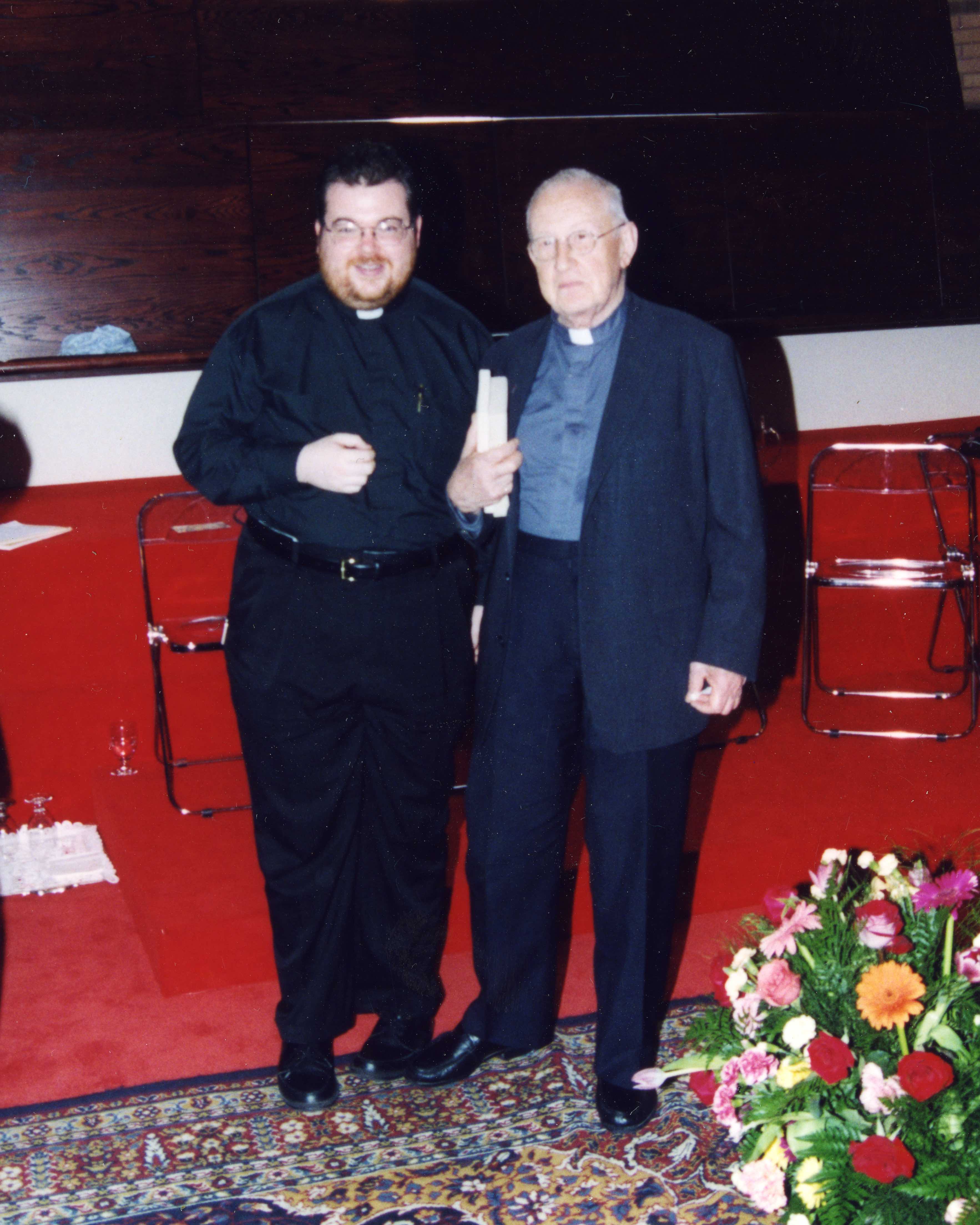
(A younger version of the author with Fr. Farnés)
I was introduced to this subject by the late Fr. Pere Farnés Scherer (1925-2017). Farnés was a Catalan priest who had studied liturgy under Dom Bernard Botte. He was involved in the conciliar renewal of various Latin editiones typicae of the renewed liturgical books. He was one of the founders of the Centre de Pastoral Litúrgica in Barcelona (Spain), as well as being the founding editor of the Spanish liturgical journalLiturgia y Espiritualidad. He was very involved in the preparation of the Spanish editions of many of the current liturgical books and, as his mother was from a prominent German-Mexican family, he was also quite involved in the preparation of various liturgical editions used in Latin America. He was particularly involved in the preparation of the various Spanish and Catalan editions of the Liturgy of the Hours. The rector of my seminary in New Jersey knew Farnés and invited him to give a number of courses to the seminarians. My own love of the liturgy and general vision of the liturgy owes a lot to Farnés.
One topic that Farnés never tired of promoting was the biennial lectionary of the Office of Readings. Today, most of the official editions of the Liturgy of the Hours contain a one-year Lectionary for the Office of Readings. However if one consults the General Instruction of the Liturgy of the Hours 143-152, which is at the start of Volume One of most editions of the Liturgy of the Hours, the Office of Readings is described as being as having a biennial cycle of readings, similar to the biennial lectionary that is currently used for weekday Masses.
When Sacrosanctum Concilium spoke of the Office of Readings in number 92 it stated that “Readings from sacred scripture shall be arranged so that the riches of God’s word may be easily accessible in more abundant measure.” This conciliar mandate led the group responsible for the preparation of the Office of Readings to compile a biennial lectionary. However, Bunigni informs us in his chronicle of The Reform of the Liturgy that the final draft edition of the Liturgy of the Hours was “an imposing mass that would require very large and cumbersome volumes.” Therefore for “technical considerations … it was decided to create an annual cycle by selecting from the two-year cycle the parts best suited to each liturgical season” even though the original biennial cycle should still be “regarded as preferable” (p. 536).
The way that Farnés told it, when the final manuscript version of the Latin editio typica of the renewed Liturgy of the Hours was presented to the Libreria Editrice Vaticana, the head printer told the editor that there was no way he would print a book that big. This resulted in the group that had spent a couple of years preparing the biennial lectionary being given a week to cut it down to a markedly inferior one-year lectionary that is still today found in most editions of the Liturgy of the Hours.
Since the mid-1990’s, I have been using a form of the original biennial lectionary and I can testify that it gives a more complete and spiritually nourishing exposure to Scripture. It is obvious that as twice as much Scripture is used, it gives a much wider selection. The one-year lectionary is notable for not including any meaningful selection from the Letter to the Romans and the Acts of the Apostles, perhaps the most important New Testament books apart from the Gospels themselves.
On a purely official level, the biennial lectionary is one of the final parts of the renewed liturgy that has yet to be published. Along with some other bits and pieces (such as the Psalm Prayers and the Office of Tenebrae), it will form the bulk of Volume 5 of the editio typica of the Liturgy of the Hours. This volume was due to be published “shortly” after the 1971 publication of the first four volumes. Needless to say, although it is still rumored to be almost ready, one would not be advised to hold one’s breath waiting for its publication. Howeve,r the biblical references for the first readings were published in Notitiae 12 (1976): 238-248, 324-333, 378-388.
In fact, various official and semi-official options for the Second Reading are available. In my next post, I will outline some of the many options and resources that are available for those who would wish to adopt this spiritual practice giving them time to make preparations to adopt this lectionary before the new liturgical year begins on December 1, 2018.
N.B. THE SECOND HALF OF THIS POST HAS BEEN PUBLISHED, SO PLEASE CONTINUE THE CONVERSATION THERE:
A third part of this series was posted in July 2021. It can be found here.

Please leave a reply.