
A Council for the Global Church: Receiving Vatican II in History by Massimo Faggioli. (Featured post at Pray Tell: chapter 5, “The Liturgical Reform and the Meaning of Vatican II.”)
Reviewed by Jakob Rinderknecht.
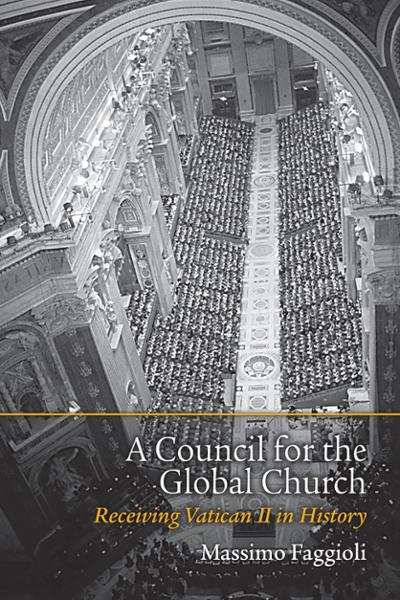 The reception of the Second Vatican Council, as readers of Pray Tell will already know, has been a fraught issue over the last several pontificates. Theologians, bishops, and others have weighed in on what the council means, how it should be interpreted, how it relates to the previous history of the church, and a myriad of other related questions. This collection of essays from well-known historian of the council Massimo Faggioli, an associate professor at the University of St. Thomas, brings a historian’s eye to this question, and offers some helpful criteria in assessing theologies of the council.
The book is structured in four parts and collects together presentations and essays that have mostly appeared elsewhere. Unlike many such collections, however the book is unified in both its argument and its scope. Faggioli makes several key arguments: First, that the council must be received historically and not merely via one of the several “narratives” which are in common circulation about it. Second, Faggioli argues on several occasions that the most radical vision of the council is found not in Gaudium et spes or other later documents, but in the first constitution of the council, Sacrosanctum Concilium.
Narratives of the Council and “Conciliar History”
Faggioli diagnoses several narratives of conciliar interpretation at work among contemporary theologians, magisterial voices, and pundits. These include the ultraconservative narrative put forward by those who reject the council, that the council is the “final link in the chain of ‘modern errors’”(44). Opposing this is the ultraliberal narrative that the council’s “major accomplishments were fatally weakened since the very beginning by excessive compromises between the reformers and the conservative forces in the Roman Curia and in the leadership of the Church” (46).
Finally, he describes a third narrative, that draws from both of the other two, and which he ties to the American neo-conservative movement (M. Novak, R.J. Neuhaus, G. Weigel). This narrative merges a traditionalist understanding that equates tradition with particular aspects of nineteenth-century Catholicism and rejects aspects of Vatican II as a “‘pacifist-communist’ takeover” of the church; with the “Jacobin-Leninist” habit of the ultraliberal model. The latter accepts that a certain intellectual elite must always be responsible for deciding what the actual experience of the church is because most of the church is not qualified. Thus, the third narrative sees the necessity for a theological and magisterial elite to fix the accepted interpretation of the council, so as to ensure absolute continuity with nineteenth century Catholicism in all its details.
In place of these fixed narratives, Faggioli argues for doing careful history of the council, that is, interpreting it in light of the available data, and changing one’s interpretation as new data is discovered. He points to the five-volume History of Vatican II, edited by Giuseppe Alberigo and Joseph A. Komonchak (Orbis), as a key text for any interpreter of the council, and repeatedly calls on theologians to attend to the best possible history as a resource for understanding what the council said.
Faggioli’s critique of these narratives of conciliar interpretation also meshes with his interpretation of recent papal history. Each of the last three popes has had a unique, and quite different relationship to the council: John Paul II was the last conciliar father to be pope, Faggioli reads him as a staunch defender of the council. Benedict XVI served as a conciliar peritus, but was skeptical in print of many post-conciliar directions. Pope Francis, the first pope to be ordained a priest after the council, Faggioli reads as giving “full and unequivocal reception of Vatican II” as it was implemented. This reception is seen particularly in the work of CELAM, the Latin-American Bishop’s conference. Benedict in particular is tied to the emerging post-liberal narrative in this book. At times this narrative is directly equated with Benedict’s “negative interpretation of the post-Vatican II era.” (49)
Should We Be Reading the Council Backwards or Forwards?
One of the most interesting arguments in this book is its contention that the real spirit of the council, and in particular its most expansive ecclesiology, do not find their best expression in the later documents, like Lumen gentium or Gaudium et spes. Instead, Faggioli argues that it is the Constitution on the Sacred Liturgy, Sacrosanctum concilium (SC), which bears the most important and distinctive work of the council. Instead of merely connecting SC to the liturgical movement which led to it, he suggests that it is better interpreted as the beginning of something new. He writes, “a deeper understanding of the new conception of liturgy developed at Vatican II and in the post-Vatican II liturgical renewal is the first step towards seeing the profound implications and the real implementation of Vatican II and of seeing what its implementation means” (117). He roots this meaning in four principles, a forward-looking ressourcement, the “rediscovery of the centrality of Scripture and the Eucharist,” “rapprochement inside and outside the church,” and the “drive for full implementation” to which the previous three lead (119).
Perhaps this argument is a counterpoint to the previous one. Doing worthy history of the council requires not only knowing what was actually happening in Rome in the early 1960s, although this is important. Instead, we also have to look at the effects of the decisions made there. We must also discover what those events mean for the global church today. Nothing has had as broad an impact on global Catholicism as the implicit ecclesiology of SC. A brief consideration of one oft-noticed change will suffice to make the point. Even if SC itself envisions only a partial and regional implementation of the vernacular (as in §36 and §101), broad permission is given for regional and local authorities to decide how to go forward (§36.3-4; §101.2-3). This permission led to an almost universal contemporary experience of the liturgy in the vernacular. Our experience of the church, because of this experience of the liturgy, is unmistakably local and historical. While reading the text of SC would not necessarily tell you that we would end up here, the responsible historian cannot excise the history of interpretation from his attempt to explain what the council means.
One Final Thought
As thought-provoking and generally helpful as this work is, I cannot pass over one major flaw: the prose is often in need of an editor. There are far too many examples of unclear or difficult writing, usually the result of needless complication. Sometimes, the difficulty proceeds to the point that the text as written bears a different meaning than the author clearly intends. I will cite only one example here: commenting on the Society of St. Pius X, F writes: “the council that this small schismatic sect created in the 1970s has always been accused of heresy and of being the cause of all evil for the Church.” (145). In its present state, it describes a council called by the SSPX in the 1970s that was itself accused of heresy. This is clearly not Faggioli’s intent, and the editor should have flagged it for clarification.
Less importantly, but still causing frustration, the book is littered with typos. These are especially found in the many non-English words, including the names of conciliar documents (e.g. Sacrosanctum Concixlium, 99). In chapter 10, “The Role of Episcopal Conferences Since Vatican II,” fully half of the references to the Roman recognitio have a final ‘n’, probably added by autocorrect and overlooked by the editors. Of course an author bears the brunt of the responsibility for their writing, but a good editor is every author’s best friend. It is unfortunate that such an important voice is needlessly dulled, rather than burnished to its brightest shine.
The contemporary Catholic cannot avoid a myriad of voices telling her what to think about this seminal event of the 20th century, especially as we celebrate the 50th anniversary of its closing. This book gathers together a collection of Faggioli’s recent thoughts about how to go about interpreting the council. His is a voice worth listening to, even when we have to strain to understand it.
Massimo Faggioli. A Council for the Global Church: Receiving Vatican II in History. Minneapolis: Fortress Press, 2015. 250 pp. $44.00 Paperback. ISBN: 978-1451472097.
Dr. Jakob Rinderknecht is a graduate of Valpairaso University (bachelor’s degree in liturgy, 2002), a graduate of Saint John’s School of Theology and Seminary (masters degree in systematics, 2005), and he earned his doctorate in systematics at Marquette University in 2015.
Please leave a reply.