
I’m in Louvain (Leuven) Belgium, having just made my annual fall trek to the University of Limerick in Ireland to be external examiner in the MA in chant, and on my way to Sant’ Anselmo in Rome to confer with the Abbot Primate and liturgy committee about the Vesperale (evening prayer in Latin chant) which I’m preparing for use at the Benedictine headquarters.
I’m in Louvain visiting Nathan Chase, who is about to begin a one-year masters program in advanced theology at the Katholieke Universiteit Leuven.
I’m staying at the venerable Keizersberg Abbey in Louvain, also known by its French name, Mont-Cesar. Some of you have heard of Lambert Beauduin, known as the “heart and soul of the Belgian liturgical movement” from 1909 on. (I wrote a bit about this in the section on the liturgical movement in Sacred Music and Liturgical Reform: Treasures and Transformations.) Beauduin became a monk of Keizersberg in 1906, and already as a novice he said,
We are the aristocrats of the liturgy; everyone must be able to be nourished by the liturgy, even the simplest people; we must democratize the liturgy.
In its heyday, the Abbey of Keizersberg numbered some 70 monks. There are four left now. We bravely made it through Latin Vespers last night, and morning prayer today was in Flemish (Dutch).
* * * * *
Nathan and I went to 10am Mass on Sunday at the Cathedral of St. Michael in Brussels. It was the anniversary of the dedication of the church, which gave us the chant propers, with readings of the day for Exaltation of the Holy Cross. Vernacular parts were a mix of French and Flemish.
Nathan and I both brought down the average age of the attendees – he was one of the few there younger than I. (I’ve completed my first half-century.) Alas, this state of affairs is rather common in these parts I think.
I hope it isn’t too much of a “you had to be there” to give my opinionated report on the Mass. I trust that many of the issues I raise also have their relevance for celebration of the Mass wherever you are.
This Gothic cathedral is stunningly beautiful! 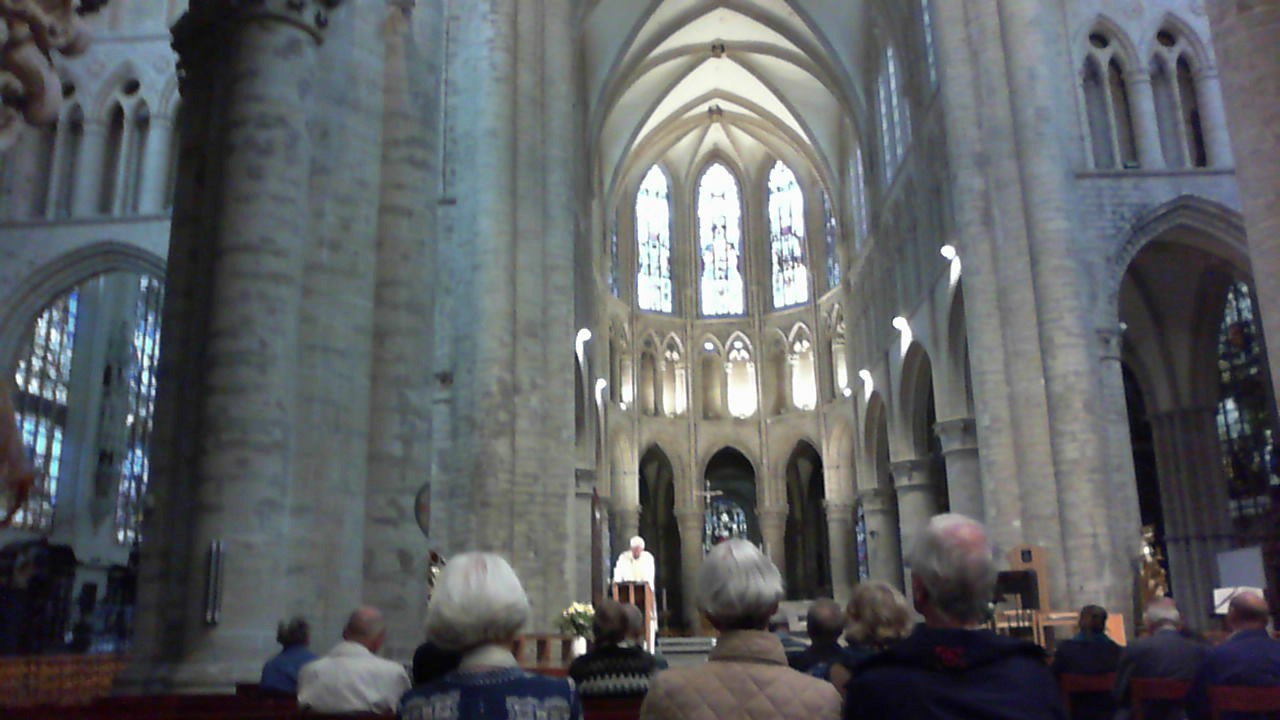
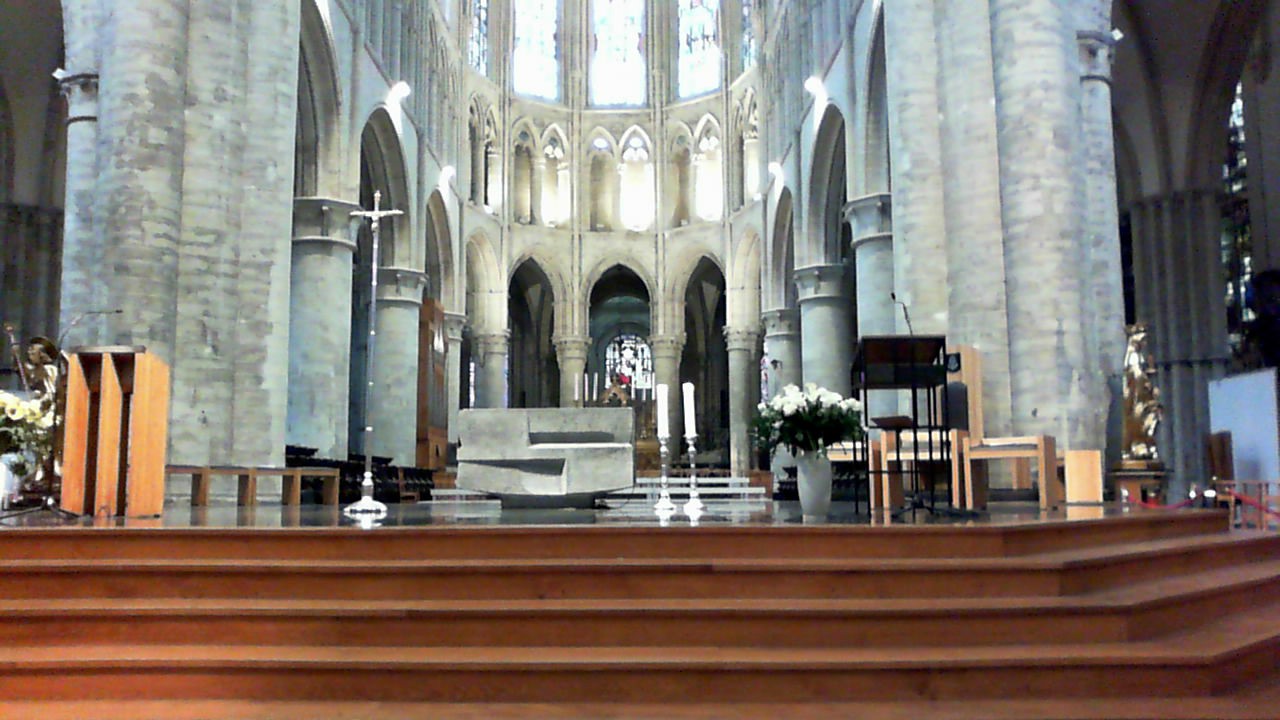
In my judgment, the rather contemporary altar fits well with its medieval surroundings:
Like in so many churches in Europe, the holy water font had just a few drops of water in the bottom of it. This means that one recalls one’s dying and rising with Christ, one’s having been immersed into the fullness of his life, by hunting for the bit of old, dirty water that hadn’t yet evaporated. Is water scarce in Europe? Are the clergy and sacristans on the front lines of the ecological movement to conserve water? So much for strong symbols.
The cathedral chant schola sang the Latin introit (Terribilis est), offertorium (Domine Deus, in simplicitate), and communio (Domus mea). Accurate, but a bit slooow and dull. Uncorrected melodies – i.e. as in Graduale Romanum and not Graduale Novum. Congregation sang in Latin (and Greek) the Asperges, Kyrie, Gloria, Credo, Te rogamus response to vernacular petitions, Sanctus, Pater noster, and Agnus Dei. Everything else vernacular.
Congregation was given text, but not melody, of Asperges me. The cantor did her best to lead us by showing visually the ups and downs of the melody, but participation was really weak. Why not print the music in the leaflet? Is paper scare in Europe? Are clergy and sacristans part of an ecological Save the Trees campaign? So much for active participation.
Organist played about the same volume for the congregational refrain of Asperges me as for the psalm verse. (He is an excellent player, btw, and did a great job on the Buxtehude preludia, A minor at prep of gifts and G minor as postlude.) This meant that the verses were drowned out, and there wasn’t a change in volume to signal clearly which part belonged to the congregation. I have a post coming soon about organ volume.
The Kyrie followed the Asperges – this feels like a duplication, but in fact the General Instruction of the Roman Missal directs that the Kyrie follows the Penitential Act, which can be replaced by the sprinkling rite. So I suppose you get to decide whether to go by the official rules or by your sense of ritual flow. (UPDATE: see the helpful first comment below from Joshua Vas.)
The Gloria – Mass of the Angels – was done in alternation between schola and congregation. No notes for us in the leaflet, just Latin text… and cantor gestures that were supposed to help us sing the melody. I admit to a bit of professorial pride that my former student Nathan Chase could sing this and some of the other Latin Mass parts by heart, having studied Latin with me at St. John’s and sung in my chant schola.
Organist played about the same volume all the way through the Gloria, thereby covering up the schola and not really stimulating the congregational entrances. I have a post coming soon about organ volume.
No pause after the first reading – Responsorial Psalm began quicker than the car horn behind you honks when the light turns green. So much for sacred silence.
Organist played about the same volume all the way through the psalm, covering up the schola and not stimulating the congregation. I have a post coming soon about organ volume.
Familiar mode VI alleluia simplex, with recited verse, which was a downer. Organ played same volume for cantor and for congregation – I have a post coming on this topic.
Here’s a nice practice, something I’ve seen only in Europe: after the reading of the Gospel, the leaflet indicated “Méditation improvisée.” I’d love to introduce this back home, but I wonder how my confreres would react to “holding up” the liturgy with organ improvisation while nothing happens.
Really looooong homily. The people were either deep in reflective thought or bored out of their skulls – hard to read European body language.
Latin Credo in alternation between schola and all. Only text and no music in leaflet, so participation was really weak.
Sanctus (Mass of the Angels) in alternation between schola and all – but we were only to sing the second Sanctus (of three) and both times on “Hosanna in excelsis.” Organ same volume throughout yet again, despite my repeated emphatic thoughts on the topic. Post coming on this.
Memorial acclamation (no text or music in leaflet) in Flemish. Most everyone seemed to know it by heart, and this sounded like the first time in the liturgy that the congregation really became a singing body. Suggestion: program something in the entrance rites that will accomplish this – an entrance antiphon, or Taize Kyrie or Gloria, or a well-known vernacular setting of something.
Exchange of peace: really friendly people, and they walked in all directions to go out and greet one another.
Agnus Dei (Angels again): schola sang first part, we all sang only “miserere nobis” and “dona nobis pacem.” Textually, this is the right way to do this litany. But I’d hate to try to change the practice back home, where everyone is accustomed to come in on “qui tollis…”
At end of Mass, something we don’t have in the U.S. since the revolution: Prière pour le roi/Gebed voor de koning. Must be a common practice, for everyone seemed to know the versicle without looking – Domine, salvum fac Regem nostrum Philippum. / Et exaude nos in die, qua invocaverimus te.
* * * * *
Lest my nitpicking about the small things give the wrong impression, let me say this: It was a wonderful blessing to celebrate the reformed liturgy, in all its simplicity and dignity and beauty, with a diverse group of believers in a stunningly beautiful space. The Word of God was proclaimed, the Sacrifice of our redemption was offered, we shared in the Bread of Life. Much to be grateful for.
awr

Please leave a reply.