Cover Art of Published Worship Aids

I’m no expert in the visual arts, but I have my preferences. I’ll try to raise my concern about cover art tentatively, and then I welcome your discussion.

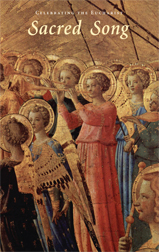
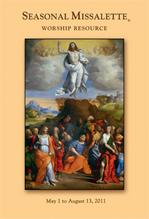
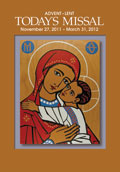
Publishers have long since gone to high quality cover art for seasonal and multi-year soft cover worship aids. Below are some examples, all with art pieces by classical and contemporary masters.

But I’m not sure that such great art is appropriate for this use. Great art is for contemplating – sometimes more devotionally, sometimes more aesthetically, most always a mix – at least for believers. A beautiful picture is a shrine of sorts. It deserves to be respected as such.

But hymnals and missalettes and annual music issues are for sticking in racks, setting on the pew seats during the liturgy, storing on carts. Am I the only who worries about Fra Angelico and Ade Bethune and the rest being thrown into all these places?

My preference is hopelessly monastic: one solid color. Same for hardcover hymnals – I’ve always preferred the look of The Hymnal 1982 to RitualSong or JourneySong. And you all think my preferred color is black – I admit it, I like the look of the Antiphonale Monasticum!

OK, if a solid color is too severe for you, how about (and now I’m thinking about seasonal aids) an abstract splash of colors, an ensemble with energy and dynamism but also calm stability?

What do you think?

Breaking Bread Sacred Song
Seasonal MissaletteTodays Missal
Anthony Ruff, OSB

Fr. Anthony Ruff, OSB, is a monk of St. John's Abbey. He teaches liturgy, liturgical music, and Gregorian chant at St. John's University School of Theology-Seminary. He is widely published and frequently presents across the country on liturgy and music. He is the author of Sacred Music and Liturgical Reform: Treasures and Transformations, and of Responsorial Psalms for Weekday Mass: Advent, Christmas, Lent, Easter. He does priestly ministry at the neighboring community of Benedictine sisters in St. Joseph.

Please leave a reply.

Comments

23 responses to “Cover Art of Published Worship Aids”

  1. Agreed, all of the ones you have pictured would look terribly busy in our pews where each hymnal rack holds four books. Currently we have World Library’s missalette and hymnal, the current missalette is solid blue with a modern interpretation of the cross on it and the People’s Mass Book is a solid green with a discrete interpretation of the cross on it. These do not scream at you from the backs of the pews.

  2. Rev. Bryan J.B. Pedersen

    My boy hood pastor used to muse on disposable missalettes in much the same way but for an even better reason, namely because these same things contain Sacred Scripture. But if I am going to use something disposable I would prefer something beautiful. For the ones trained in contemplation they should be able to use it regardless of the medium. For those not trained the constant engagement with what is beautiful provides a better support structure to the core doctrines of the faith expressed in worship than those things that are banal and ugly.

  3. I agree with your primary preferenceโ€””an abstract splash of colors” is worrying, but the ’82 Hymnal is very nice. In the Roman Rite, “noble simplicity”โ€”which is by no means the same as austerityโ€”should be the watchword for things like this.

  4. My preference is hopelessly monastic: one solid cover. Same for hardcover hymnals…

    Agreed! One would hope that a simpler, more “monastic” design would prevail not only in the covers but in the pages between them. One example: Breaking Bread, which reads like the Yellow Pages. We know these comboxes are overrun by liturgists, let’s hope some book designers notice as well.

  5. Peter Rehwaldt

    Anthony, the same comments you make here could be aimed at the St. John’s Bible. “Just put the words on the page, the pages in the book, and give the book a nice cover that says ‘Bible.'” It also seems odd to hear you say that a book (hymnal, missalette, etc.) that contains texts and tunes that paint powerful pictures in the minds of the singers should be prohibited from also including actual images.

    Hymnals *are* used for contemplation and devotions. As a young child, while others tried to follow a particularly boring and poorly constructed sermon, I contemplated the fine print beneath the hymns. “Who is this Catherine Winkworth, that seems to have translated so many hymns?”

    That said, the choice of images matters. I’m surprised, quite frankly, that a volume entitled “Breaking Bread” does not use an image that contains bread? On the other hand, “Sacred Song” gives us a cover that immediately connects today’s singers with the choir of believers throughout history. The two missalettes pictured above each reflect the season, in the same way that cloth banners and paraments do.

  6. Fr Jim Blue

    Well I am most bothered by paperbacks with glossy reprints of icons. Unlike works of art there is a very unique and elevated form of spirituality associated with iconography which may not be fully appreciated in western Christianity. I believe that our Reverend and Dear poster awr has a point … and might I respectfully suggest that relegating sacred images to mere decoration is particularly vulgar with regard to iconography. In the west such misuse might betray an insensitivity toward those who hold iconography as a very special kind of art – in fact more-than-“mere”-art.

    1. Jordan Zarembo

      re: Fr Jim Blue on December 2, 2011 – 1:20 pm

      Agreed, Fr. Blue. A disposable item such as a missalette should not contain even a printed reproduction of an icon. I also agree that western Christians often do not understand the liturgical and mystical significance of iconography in “eastern” Christianity.

      That said, the iconoclasm of recent altar liturgical books has bothered me precisely because the illumination of missals emphasizes the contemplative aspect of liturgical actions. In my parish all Masses are said ad orientem. I was very disappointed that I could not see a Canon page as the priest began to recite the Roman Canon from the new translation. The page facing the te igitur was blank, or decorated with an image that could not be seen from the back of a chapel. By contrast, whenever I attend the EF, it is not difficult to notice the large rood of the Canon page.

      I understand that many, if not most, liturgical books for the OF presume versus populum worship. Perhaps publishers do not find it profitable to produce a more expensive missal just to provide illumination for the celebrant’s eyes only. I wonder, however, if illumination is spiritually profitable for a celebrant. Wouldn’t a celebrant wish to meditate on a visual representation of the mystery of the Cross while reciting the eucharistic prayer?

      Missal iconoclasm is not at all related to the theological orthodoxy of the 1970 Missal. Even so, the notion that the spoken and recieved word trumps iconographic contemplation ruptures critical bonds between text, spoken word, and the interior spiritual life.

  7. Michael Silhavy

    Let’s not forget about how the book feels in the hand. Every now and then I’m asked to lead a pro-con discussion in parishes about various types of participation aids: hymnals, screens, self produced, paper back. When I mention the experience of holding a book in one’s hand, I’m usually greeted with blank stares. I don’t think we value this experience enough. Then again, others have complained about the weight of hymnals, as if an 80 year old Presbyterian is stronger than an 80 year old Catholic….

    This tactility is found in Worship III and Gather I. The designer was keen on the concept of “holding the cross” in your hand as you picked up the hymnal. (Take a look at the cover design and notice the cross.) One can just barely sense with one’s fingers the design. People’s Mass Book does the same to a degree on the front cover.

    I say let’s honor the craft of graphic designers and ask them to create something new rather than taking an easy way out with recycling imagery. Not that graphic designers can’t refashion exisiting artwork in their own work. No one was better than Frank Kacmarcik and his covers for Worship magazine.

  8. I see your point, but those images of religious art are everywhere, from music CD covers to coffee mugs to posters of the Flying Spaghetti Monster. In a way, they don’t belong to the church or believers, they’re a kind of communal property of our culture. Maybe putting them on the cover of religious-themed books like missals is a way to redeem them? Think of the art in the medieval books of hours … maybe modern hymnals can be thought of as contemplative art for all us in the pews instead of just the wealthy of the past. I do wish, though, that more original contemporary religious art was given a chance to grace the covers.

  9. M. Jackson Osborn

    I agree fully with Fr Ruff and Fr Blue –
    A hymnal, a missal or ‘missalette’ (I cringe at the rather silly sounding ‘worship aid’) would best resemble The Hymnal 1982, or 1940, or the English Hymnal – or the London oratory’s The Catholic Hymnbook. Using icons and sacred art as covers for these books cheapens the art by using it as a competitive marketing device. Art, and especially iconography, is for meditation and spiritual instruction and contemplation. Its purpose and value are subverted and bastardised when used to make one’s books seem more attractive that one’s competitors, or to induce fleeting emotional responses. On the other extreme are the tasteless designs found on such as the strangely popular Ritual Song and Gather: one would never guess that these books served the purposes of a holy ritual… but perhaps that is just as well, because they do so only poorly.

  10. Mgr Bruce Harbert

    Surely this is the place for a tribute to Frank Kacmarcik, who produced the covers for Worship monthly for many years. His work is simple, beautiful (ravishingly so in my view) and he had an uncanny gift of catechising through pictures. It offers a model for the uses you have in mind, Anthony. Indeed, I would like to see a lot of his work re-used, since not many people now come across it in its original context.

    1. M. Jackson Osborn

      Mgr Bruce –
      If the work of Frank Kacmarcik of which you speak is the art I think it may be, I agree with your assessment of it. Is it at all available in a book or reproducable form? If so, can you point me to the publisher or source?

  11. Jim McKay

    Art does not stay on covers, but finds its way into minds and memories. Even if it is subconscious, remembering an image and associating it with liturgy gives a depth like nothing else.

    I prefer that modern artists be encouraged, rather than just revivals of past styles and images. Part of that encouragement is accepting some bad art so that better works have a place to be displayed. Part of it is immersing people in art. Part of it is valuing artist’s contributions, not just by paying them but also by not disdaining.

    Icons are different, and their sacred character should be respected.

    St Bernard and Abbot Suger framed the basic issues a millennium ago. There is a place for reserved “custody of the eyes” and for enriching spectacular displays.

  12. Father Thomas F.A. O'Brien

    Three years ago, when I was first appointed a pastor, I invested in the production of weekly worship aids, customized to the particular week or solemnity. They include all the music needed for the Mass(es), the orations, and the ordinary parts to be said by the congregation. Additionally, they are published in a booklet form that has as its cover either a seasonal image or a particular image (as for the Immaculate Conception, for example). The image is in the public domain, and so no rights need to be secured. My sense is that folks who enter the church love these worship aids–they are beautiful, suggest a certain “heft,” and use art to inspire prayerful reflection and an appreciation of the sheer beauty of so much of the Church’s art.

  13. Cathy Crino

    I have to disagree with most of the posters here. I use a great deal of sacred art on sheets I give to folks for prayer services (RCIA, prayers to begin meetings, when organizing them for kids, etc.) I find it has a two-fold purpose: it introduces them to the wealth of Christian art and it also helps to focus those who have more visual intelligence.

    I love to see Fra Angelico on anything that is associated with worship. And, if someone asks, “Who painted that?” all the better!

    1. The distinction is being made between iconography and other sacred art, as far as I can tell. Perhaps commenters could go into more detail and further explain the difference between icons and other forms of sacred art, specifically as far as their use in ephemeral products like missalettes.

    2. Linda Reid

      Cathy, I must agree with you on all points, especially Fra Angelico!!
      I just finished designing our Christmas worship aid and the Fra Angelico nativity detail is on the cover!

  14. Aaron Reynolds

    I agree completely Father Ruff! Being a Catholic who was a former Episcopalian, one of the things that I expected at my first Catholic Mass about five years ago, was permanent hymnals and a “Catholic” version of the Book of Common Prayer in the pews for everyone to use. Sadly, this wasn’t so. The parish I attend now uses Breaking Bread, and while its easy to use, I would much rather have a permanent hymnal (perhaps one based of the Hymnal 1982?) and a permanent missal in the pews. Perhaps this is something we could learn from the Episcopal Church. I find that when a Church has permanent books and hymnals in the pews for the congregation to use, it gives the worship a certain feel of dignity, and permanence. The disposable missal/hymnals, while convenient, don’t have that same feeling. To me they almost feel cheap. Also, when a Church has a separate permanent missal and hymnal, I think it allows for more hymns to be included in the hymnal. Breaking Bread, the only disposable missal I’m familiar with, is half missal, half hymnal. Compared to the Hymnal 1982, Breaking Bread doesn’t have near the number of hymns the 1982 does. Lastly, if Churches were to invest in permanent hymnals and missals, it would cut down on the environmental impact of all the disposable missals and hymnals that have to be re-issued at the beginning of every Church year, then tossed out.

  15. M. Jackson Osborn

    Amen, and amen to Aaron Reynolds: the you are spot on with the word ‘cheap’.
    And, by the way, Aaron: haven’t you an Anglican Use parish any where near?

    By the way, to all – I qualify my comments above: I do think that sacred art (not distinct from, but including, icons) is quite appropriate for use on worship leaflets. It not only is condusive to meditation on the theme of the day, it makes of the leaflets something more than a temporary and throw-away thing. I, for one, am among many who save and revisit them.

    And, JP asks about the distinction between ‘sacred art’ and icons. There is one, though ideally, there shouldn’t be. An icon is a deeply inspired gateway to the world beyond and a communication from those saints and sacred objects and events that are ‘written’ by iconographers who are steeped in the language of this ancient art. The ‘sacred art’ of the west sometimes does, but too often does not, hue to such a spiritually, theologically, focused purpose: it often appeals gratuitously to shallow emotion and a certain insipidly spiritual ‘prettiness’ which is the antithesis of iconography. (This comment, of course, has the limited validity of all generalisations.) Also, in much later iconography, there is a noticeable influence of western art which dilutes the purity and power of classical iconography.

    And, there are those who are far better qualified than I to attempt throwing light on this matter.

  16. Sean Whelan

    I finally removed our Gather Comprehensives, first edition. They looked like they had been in battle (and lost.) Now we have in the pews a folded pew card of the responses (Faith Catholic) and a half-sheet with the Mass setting we’re using (Storrington Mass.) We had Seasonal Missalettes and then Sunday’s Word. Now we have a few SW for those who wish to pick them up in the gathering space before Mass. I may be all alone here, but I simply cannot stomach the “fine Italian art” so often used on covers. To me it’s just gaudy. In our weekly song sheets, I use either Steven (Martin) Espamer’s Clip Art or Brother Michael McGrath’s from WLP with a preference for the former.

  17. Julie Boerio-Goates

    While I enjoy reading the comments posted here, there are times in which I just can’t relate to the world most of you inhabit. At my parish here in Utah, we have six masses on a weekend, three in English, three in Spanish. (Each weekend one of the two priests drives 40 miles to our mission to say one more Spanish Mass). There are two and 1/2 English choirs and four Spanish Choirs; each has its preferred music. Our parish has about 300 English language families and between 1500 and 2000 Spanish families. It spans the gamut from Ph.D.’s to recent immigrants from the campo. We’ve been going to Mass in a gymnasium for 12 years, raising money to build a true worship space. In February we’ll make the move to a church. We’ve been trying to find one bilingual hymnal that will meet the needs of our diverse community, that the choirs will agree to use and that we can afford.
    Could you please start a thread sometime about how to do bilingual liturgies well? Any advice regarding hymnals would be gratefully considered.

  18. Julie, bilingual liturgies of the kind you mean are almost inherently divisive. The best way to handle communities with several languages is to have the liturgy in latin (as, IIRC, the US Bishops suggested in Sing To the Lord).

    1. Julie Boerio-Goates

      My first, only partially facetious response: Is there a setting for a Latin Mass with guitars and drums? We have a non-functional organ; no member of the parish plays the organ and there is no one with an interest in learning to play the organ. Beside, I think the result would be to privilege the Spanish community that could understand more of the Latin, while providing nothing for the English to connect with.

      My second response: In fact, we have been doing bilingual liturgies for the major liturgies (Holy Thursday, Holy Saturday, Christmas Eve) and some sacramental liturgies (Confirmation) in this parish for more than 20 years. We have figured out somethings that work. People who participate in these liturgies regularly are comfortable with them. No one finds them optimal, but friendships across language communities have developed through working on a common liturgy. There is not the hostility that was encountered years ago. It takes patience and persistence. Initially, we had two choirs bouncing up and down, alternating with the language chosen for a particular prayer or hymn. Now we have a “celebration” choir that starts to meet before the major liturgies and all members sing both languages.

      What I was hoping for were some suggestions regarding both liturgical principles and nitty-gritty practices e.g., Is there a recommended way to partition out the languages across the various Mass parts? Should the Psalm be tied to the 1st or 2nd reading in language? Given that there are no bilingual lectionaries or Gospel books, how do you respectfully present the ambo texts for lectors? What’s acceptable regarding sacramentaries?

      Sorry, the Latin is just a non-starter.


Posted

in

by

Tags:

Discover more from Home

Subscribe now to keep reading and get access to the full archive.

Continue reading