
This experience was made possible through the grant “Sustained Encuentro: Accompanying One Another on the Way” which empowers the partnership between Saint John’s School of Theology and Seminary and the Mexican American Catholic College.
Earlier this year, I had the invaluable opportunity to attend the Hispanic Ministry in the 21st Century Workshop at the Mexican American Catholic College in San Antonio. This immersive experience provided me with a rich exploration of the diverse perspectives, traditions, and customs deeply embedded in Hispanic and Latino culture. One particularly impactful component was the border immersion trip, which offered firsthand insights into the challenges and realities faced by communities at the border, illuminating issues of migration, identity, and faith. Engaging directly with residents and organizations opened my eyes to their stories and struggles, significantly enriching my understanding of the complex dynamics at play.

Border Walk – Hidalgo, Texas, Photo by Author
In this context, I was struck by the concept of the mystical body of Christ, which embodies the profound unity of all believers. This unity, forged through faith and participation in the sacraments, spans across time and space, connecting those present with those who have gone before us. My experiences intertwined beautifully with Marian imagery, especially that of Our Lady of Guadalupe and Our Lady of the Valley—figures that hold immense significance in the cultural and spiritual lives of many people I encountered.
Attending Mass at the Basilica of Our Lady of San Juan del Valle further deepened my sense of community. Surrounded by rich symbolism and evocative Marian imagery, I found myself reflecting on the journeys of immigrants and the core values of togetherness and love that transcend borders and societal divides. As I stood in the shrine, enveloped in the fragrance of roses and the glow of lit candles, I gazed up at Our Lady of San Juan del Valle, pondering the countless individuals she has guided and protected throughout their journeys. This moment overwhelmed me with emotion and reminded me that not everyone has the chance to experience such profound connection. Often, we let our preconceived notions and biases blind us to the realities of others’ lived experiences.
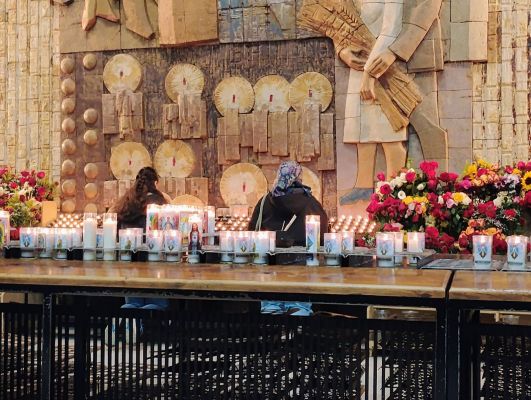
Andrenique and Maria Praying at the Basilica Of Our Lady of San Juan del Valle – National Shrine, Photo by Emma Johnson
As a Methodist engaging with the Eucharist in a Catholic church, I often feel a complex emotional response. There is a clear feeling of reverence and awe, tempered by the acknowledgment of my exclusion from the sacrament. The Eucharistic celebration offers a transformative opportunity for spiritual communion, yet the requirement for participation serves as a reminder of the theological complexities and divisions that persist among Christian denominations (which is a story for a different day). This mirrors the realities faced by the individuals I met; it underscores the intricate dynamics of belonging and inclusion. In reflecting on this I think of the words of the late Fr. Gustavo Gutiérrez-Merino Díaz in his book A Theology of Liberation: History, Politics and Salvation:
Without a real commitment against exploitation and alienation and for a society of solidarity and justice, the Eucharistic celebration is an empty action, lacking any genuine endorsement by those who participate in it. (150)
Ultimately, this experience has become not just a moment of personal reflection, but a crucial reminder of the complexities tied to our shared faith and the concept of community. It encourages me to approach ministry and community engagement with a renewed commitment to understanding and embracing the diverse experiences that shape our collective journey.

–Andrenique Rolle, Editorial Assistant at Pray Tell Blog, Saint John’s School of Theology and Seminary
Please leave a reply.