
For the priest who has everything

I like to think of myself as a fairly avid follower of things liturgical, so I was surprised when, a few weeks ago, I came across a liturgical accoutrement that I had never encountered before. This was not some obscure item from the Middle Ages or a particular article used in the Syro-Malabar Rite. What I had come across was a STYLUS PASCHALIS or stylus.

During the Blessing of the Paschal Candle during the Easter Vigil, the rubrics say:

After the blessing of the new fire, one of the ministers brings the paschal candle to the Priest, who cuts a cross into the candle with a stylus. Then he makes the Greek letter Alpha above the cross, the letter Omega below, and the four numerals of the current year between the arms of the cross, saying meanwhile:

  1. Christ yesterday and today

(he cuts a vertical line);

  1. the Beginning and the End

(he cuts a horizontal line);

  1. the Alpha

(he cuts the letter Alpha above the vertical line);

  1. and the Omega

(he cuts the letter Omega below the vertical line).

  1. All time belongs to him

(he cuts the first numeral of the current year in the upper left corner of the cross);

  1. and all the ages

(he cuts the second numeral of the current year in the upper right corner of the cross).

  1. To him be glory and power

(he cuts the third numeral of the current year in the lower left corner of the cross);

  1. through every age and for ever. Amen.

(he cuts the fourth numeral of the current year in the lower right corner of the cross).

The Easter Vigil in the Holy Night # 12 In The Roman Missal: Renewed by Decree of the Most Holy Second Ecumenical Council of the Vatican, Promulgated by Authority of Pope Paul VI and Revised at the Direction of Pope John Paul II, Third Typical Edition (Washington D.C.: United States Conference of Catholic Bishops, 2011), 345.

I had never seen a special implement for this and had used a nice ball point pen, one of the nails with the grains of incense and even my finger to trace out the cross on the candle.  Also I have never actually seen a celebrant carving the cross and letters into the candle, they are painted on, already engraved in the wax or even applied with a transfer. So the stylus is used in a symbolic way to trace out the design on the candle.

So I was surprised to see it advertised on the website of Watts & Co in London. It cost me about $70 to buy it and have it shipped to Ireland. I consider this to be bargain basement as Watts & Co. are famously expensive – although they produce very beautiful vestments, I fear that the value of the life insurance policy that the Archdiocese of Newark has on me would not cover the price of a cope from this company!
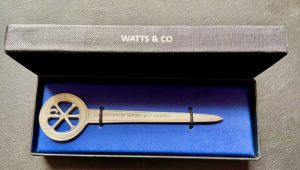
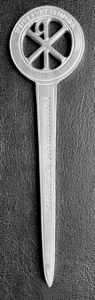
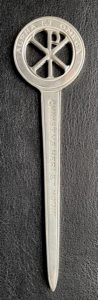
My stylus is made of pewter and looks somewhat like a blunt letter opener. It comes in a nice cardboard box and has the words of the blessing engraved on it: Christus heri et hodie, Principium et finis, Alpha et Omega. Eius sunt tempora.
I am sure that PrayTell readers will tell me that they have always used an authentic stylus and that some church goods store they know stocks twenty different brands.  But I was happy to come across this one and I hope that next year I will be able to use it with gusto when hopefully our churches will be open again and we will be able to celebrate the Paschal Vigil.

Fr. Neil Xavier O'Donoghue

Neil Xavier O’Donoghue is originally from Cork, Ireland. He is a presbyter of the Archdiocese of Newark, NJ who has ministered in parishes on both sides of the Atlantic. He has spent many years as an academic mentor to seminarians. Neil currently serves as Programme Director for Liturgical Programmes at the Pontifical University and as Acting Director of the National Centre for Liturgy. Since 2020 he has also served as the Executive Secretary for Liturgy to the Irish Catholic Bishops Conference. He has studied at Seton Hall University (BA, MDiv), the University of Notre Dame (MA), and St Vladimir’s Orthodox Theological Seminary (MTh). He holds a Doctorate in Theology (Ph.D.) from St Patrick’s College, Maynooth and is in the process of completing a second doctorate (D.D) in the Pontifical Facultad de Teología Redemptoris Mater in Callao, Peru. Neil has published a translation of the Confessio of St. Patrick: St. Patrick: His Confession and Other Works (Totowa, NJ, 2009), as well editing the third edition of Fredrick Edward Warren’s The Liturgy and Ritual of the Celtic Church (Piscataway, NJ, 2010). In 2011 the University of Notre Dame Press published The Eucharist in Pre-Norman Ireland an adaptation of his doctoral thesis and in 2017 the Alcuin Club published his Liturgical Orientation: The Position of the President at the Eucharist. His articles have appeared in The Irish Theological Quarterly, New Blackfriars, The Furrow and Antiphon. He writes a monthly article on some aspect of the theology of Pope Francis in the Messenger of St. Anthony and blogs regularly at PrayTell.

Please leave a reply.

Comments

4 responses to “For the priest who has everything”

  1. Pádraig McCarthy

    Cutting into the wax of a candle could be rather difficult, unless you are satisfied with just a surface scratch! Practice beforehand on another candle of similar diameter. Be prepared for lines which are not quite straight, and for numerals which are distinctly wobbly! It also requires that the candle be held very firmly, more so than being held in the hands of another person. Perhaps have it held resting on a support or stand. Heating the stylus beforehand, perhaps in boiling water, may help a little, but not much!
    I wonder was the candle wax in past centuries of a softer variety?

  2. Paul Inwood

    Most priests that I have seen over the past 66 years have used a metal letter-opening knife, such as this one, rather less expensive than the Watts stylus:
    https://www.amazon.co.uk/Westcott-Letter-Opener-Stainless-Handle/dp/B00BSNPSSC/ref=asc_df_B00BSNPSSC/?tag=googshopuk-21&linkCode=df0&hvadid=232077487108&hvpos=&hvnetw=g&hvrand=3022363609043605844&hvpone=&hvptwo=&hvqmt=&hvdev=c&hvdvcmdl=&hvlocint=&hvlocphy=1007089&hvtargid=pla-445108659994&psc=1

    Even if the candle has a pre-printed transfer, priests still trace, if not actually cut the wax, for the cross and the numbers.

    So sorry that Ireland is not getting a Triduum this year. In England and Wales, we are celebrating in a much-reduced fashion, unlike last year when everything was cancelled.

  3. Karl Liam Saur

    Well, if a stylus were of metal other than pewter (the melting point of which is roughly the temperature of frying oil), the tip could be heated in the fire….I suspect that’s the assumption behind the original practice. The melting point of pure beeswax is about 65C/150F.

  4. Martin How

    In the best tradition of Anglican compromise we go mid way between a ball point pen and a special liturgical instrument and use a steel nibbed ink pen of the type that you would have dipped in an ink well up to the mid 1960s in primary school in England. The priest uses it to trace over the symbols on the transfer during the blessing of the candle.


by

Tags:

Discover more from Home

Subscribe now to keep reading and get access to the full archive.

Continue reading