
In honor of the Season of Creation (September 1 – October 4), Pray Tell is running a series of posts on how the liturgy can help us to appreciate the wondrous gift of Creation, and how it can challenge us to care for Creation. Each post will reflect on one of the seven days of Creation described in the first chapter of Genesis.
“In the beginning, when God created the heavens and the earth — and the earth was without form or shape, with darkness over the abyss and a mighty wind sweeping over the waters — Then God said: Let there be light, and there was light.
God saw that the light was good. God then separated the light from the darkness. God called the light “day,” and the darkness he called “night.” Evening came, and morning followed—the first day.” Genesis 1:1-5

My first exposure to liturgical worship was as a teenager at a “high church” Episcopal parish in South Carolina. It was the custom there at the end of the liturgy for everyone to remain reverently in the pews until the acolytes emerged from the sacristy to ceremoniously snuff out the altar candles, after which everyone felt free to leave. One of the parish wags (there were more than a few) somewhat archly referred to this as “fire worship.”
While Christians do not worship fire, or any creature for that matter, fire and light are fundamental religious symbols. The mysterious nature of light—invisible in itself but making all things visible—has long suggested it as a metaphor for the mystery of God. The 12th-century Muslim philosopher Ibn Rushd wrote that the analogy of light, “is very appropriate to the Glorious Creator because it combines the claim that he is perceptible—though the eyes are incapable of perceiving him—and intelligible—even though he is not a body…. since light is the noblest of all existing things, it is necessary to represent to [ordinary people] the noblest of all beings by it” (Exposition of Religious Arguments). When the bishops at Nicaea sought to find words to express the mystery of Christ’s divinity they called him “God from God, light from light,” an image later glossed by the abstract term homoousious. St. Francis praised the sun as an image of its creator:
Praised be you, my Lord, with all your creatures,
especially Sir Brother Sun,
who is the day and through whom you give us light.
And he is beautiful and radiant with great splendor;
and bears a likeness of you, Most High.
T.S. Eliot echoes Francis’s praise of God for the lesser lights of creation:
Greater Light, we praise Thee for the less;
The eastern light our spires touch at morning,
The light that slants upon our western doors at evening.
The twilight over stagnant pools at batflight,
Moon light and star light, owl and moth light,
Glow-worm glowlight on a grassblade.
Light Invisible, we worship Thee! (“O Light Invisible”)
It is perhaps fitting that God’s first creative act would be to make present in creation this potent symbol of the divine. In speaking “Let there be light” as the first creative words, God wills a world in which God’s “invisible attributes of eternal power and divinity have been able to be understood and perceived in what he has made” (Roman 1:20). The universe from the outset is saturated with light because it is saturated with divine activity, holding it in existence at every moment and leading us to knowledge of our Creator.
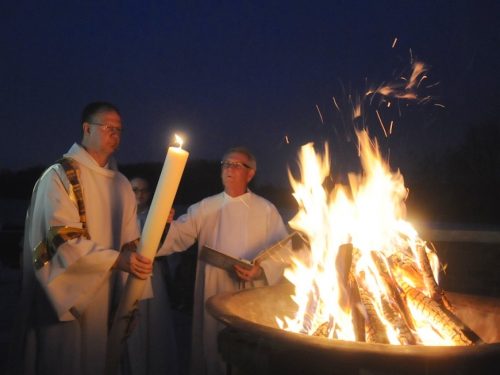
Liturgically perfected by grace, this natural symbol of light speaks to us of Christ, “the true light, which enlightens everyone” (John 1:9). The rhythm of day and night, light and darkness, structure the daily prayer of the church and are sanctified by that prayer. The arrival of Christ—“a light to enlighten the nations and the glory of your people, Israel”—is celebrated with the blessing of candles at Candlemas. The extinguishing of candles in the office of Tenebrae points us to Christ’s death and the kindling of light in the Easter Vigil begins points us to his resurrection. The Easter candle is censed and praised as a fundamental symbol of the risen Christ: “an evening sacrifice of praise….a fire into many flames divided, yet never dimmed by sharing of its light.” Our sharing in Christ’s enlightening of the world through baptism is driven home in the presentation to the newly-baptized of a candle lit from the Easter candle:
You have been enlightened by Christ.
Walk always as children of the light
and keep the flame of faith alive in your hearts.
When the Lord comes, may you go out to meet him
with all the saints in the heavenly kingdom. Amen.
We kindle fires in our liturgies in anamnesis of God’s creative act. And yet, as with any human mimesis of the divine, this is a two-edged sword. Commentators have long noted the irony in the serpent’s temptation of humanity: “you will be like God” (Genesis 3:5); but God has already made them in God’s image, an identity not won by their striving but given by God’s generosity. In our desire to make ourselves godlike, we forget the God who made us.

And so it is with the lights that we kindle in imitation of God’s primal creative act. The lights of our cities obscure the stars. Our coal-fired furnaces pollute the air. We burn the earth’s lungs to make grazing land for hamburgers. The gift of light that saturates the cosmos can be twisted by our disordered self-regard, the primal sin of refusing our identity as creatures dwelling with our fellow creatures and kindling fires to serve our own ends.
The deacon sings in offering the Easter candle: “Receive it as a pleasing fragrance, and let it mingle with the lights of heaven.” Perhaps the liturgy can teach us to make the lesser lights of human making not signs of our self-assertion, but humble offerings to the uncreated source of light, dwelling peacefully with creation’s other lights.

More to come, in the series on Creation:
James Hadley on Day Five, Katie Harmon on Day Six, and Teresa Berger on Day Seven.
Click here to read Rita Ferrone on Day Two, Jill Crainshaw on Day Three, Alan Hommerding on Day Four.
Please leave a reply.