
Church, ecclesia, is people: those called out, gathered, set apart, by the Lord. But the places to which the church is called out, the places where it gathers, are important: church buildings are the house of the ecclesia, signs of its presence within a larger community — and therefore signs of the presence of the living God, indeed the very house of God.
What is this place where we are meeting?
Only a house, the earth its floor.
Walls and a roof sheltering people,
windows for light, an open door.
Yet it becomes a body that lives
when we are gathered here,
and know our God is near.Huub Oosterhuis, “What is this Place?” tr. David Smith. See ocp.org for ordering information.
When a church building is destroyed by fire, whether accidentally or deliberately, the church hurts: it grieves a loss, becomes homeless, wanders in the wilderness — but it survives nonetheless.
It has become my custom to check in on Facebook before Evening Prayer, particularly to glean from the posted needs and desires of my friends a short list of pressing intentions for remembrance during the Office. Yesterday, the first status update I read was “N. knows that life can change so suddenly — praying for the VTS community.”
VTS: the initials stand for “Virginia Theological Seminary,” in Alexandria, VA, the largest of the eleven accredited seminaries in the Episcopal Church. A quick glance at some other postings indicated that no one had died, but that a tragedy had unfolded nonetheless. Immanuel Chapel, the historic 129 year-old heart of the seminary campus and one of two worship-sites for Immanuel Church-on-the-Hill, had been completely destroyed by fire.
Now, the students of Virginia Theological Seminary and those of New York’s General Theological Seminary, my alma mater (one of them, anyway), have had a long-standing rivalry that extends from the football field to — yes — the chapel. Virginia Theological has a “low-church” reputation among the largely “high church,” Anglo-Catholic population of General’s students — though in fact VTS is squarely at the center of the Episcopal Church’s “broad-church” tradition. (The Wikipedia articles to which I’ve linked these intramural Anglican terms are, surprisingly, rather accurate.) No doubt, Virginia’s students have their own ideas about those crazy “Penguins” to the north, who can’t seem to show up for an inter-seminary football match without bringing a thurible. . . or cassocks, surplices, tippets and everything else a liturgics squad (the seminary equivalent of a pep-squad?) might need. But last night these rivalries fell away as many of General’s students, faculty and alumns posted prayers and notes of concern for their sisters and brothers at VTS; and today many GTS Penguins have changed their Facebook profile picture to one of the now-ravaged window over the Immanuel Chapel altar with its iconic framing words, “Go ye into all the world and preach the Gospel.”
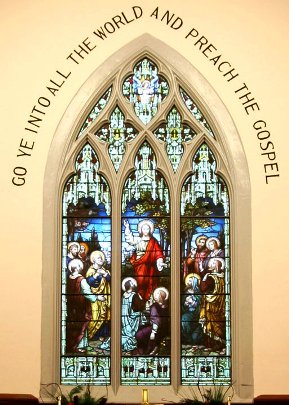
The rivalries fell away because every seminarian knows and experiences the importance of worship in theological education. Most Episcopal seminarians take part in some aspect of worship on a daily basis, whether through the Holy Eucharist or the Daily Office, or both. Being “in chapel” is for many the most formative experience of their seminary years, for it is there that the seminarian is steeped in the traditions she or he is expected to carry on. Chapel is the place to which one brings her or his pains, struggles, frustrations — as well as joys and triumphs; chapel is the place where one learns to sing boldly the everlasting hymn of “Angels and Archangels and. . . all the company of heaven.” Chapel is the place where “we believe” and “we confess” are held together and wonderfully transfigured into “send us out.” Chapel is the place of worship, the place of formation — and of transformation, as E. Byron Anderson points out:
Formation through worship is. . . an apprenticeship in the Christian life. We practice living as Christians in prayer, song, bath, and meal; we practice a new language as we hear and tell a new family story; we practice a way of keeping time that has its own new year, its own days for celebration and lamentation; we practice being a people called to holy living. Formation through worship acknowledges that liturgical experience is a personal and communal experience that we know but cannot name. While its meaning can be interpreted (mystagogy) and anticipated (instruction) that meaning cannot be communicated other than through the ritual event itself. This is why what we say, sing, and do in worship is so important.
Therefore when we approach questions about the role of the seminary chapel in pastoral formation. . . [we] begin to rediscover the intrinsic formational and educational possibilities of worship for the church as a whole. We discover that the liturgical sacramental life of the church is perhaps even the primary formative and transformative practice of the church, through which we offer ourselves to God with all that we are, in which we encounter the tangible, tastable [sic] love of God for the world, and by means of which we are compelled to loving service in the world.
E. Byron Anderson, “Worship and Formation for Ministry,” in Siobhán Garrigan and Todd E. Johnson, eds., Common Worship in Theological Education (Eugene, OR: Pickwick Publications, 2010), 175-176.
Yesterday’s fire at Virginia Theological Seminary has deprived that community of its worship space, its chapel — its place of gathering and prayer, of memory and hope. But no fire can destroy the faith of a community, no conflagration can terminate its gathering, singing and praying — even if these be, for a time, disrupted. In the immediate aftermath (barely a day later), little else is certain, as the Very Reverend Ian Markham, dean of Virginia Theological Seminary, reports. Certainly a new house for God and God’s ecclesia will be built at Virginia Theological Seminary in time; but for now, faith will sustain, and the transforming power of worship will go on. Thanks be to God for that!
Please leave a reply.