
(Photo: Jeffrey Smith)
The Liturgical Movement of the 20th Century in the West
The Liturgical Movement in the West is well known. For the Roman Catholic Church, the work of the pioneers of this movement was codified and given ecumenical import at Vatican II with the promulgation of the Constitution on the Sacred Liturgy (Sacrosanctum Concilium). The document stressed the centrality of the Eucharist as the “source and summit” of the activity of the church.[1] The Constitution also emphasized the important formative and educational aspects of liturgy and asserted that in order to be continually formed by the liturgy, the faithful “should be led to take that full, conscious, and active part in the liturgical celebrations which is demanded by the very nature of liturgy.”[2] The Fathers of the Council also gave guidelines for reform, including the use of sound tradition, a careful study of the structure and meaning of the liturgy, structural clarity, the primacy of Scripture as well as acknowledging other pastoral considerations (e.g. the use of the vernacular and inculturation.)
The Liturgical Movement of the 20th Century in the East
Less well known, is the Liturgical Movement of the East. In particular, the late nineteenth and early twentieth centuries were a time of active theological and liturgical scholarship in Russia, in particular. For instance, over five hundred scholarly theological monographs on biblical studies, patristics, church history, and liturgics were published in Russia during these years, mirroring the enthusiasm for these studies in the Christian West. In addition, liturgical and pastoral concerns were brought into focus during this time.
Bishop Nazarius of Nizhni-Novgorod summarizes the formative value of liturgy and the need for the faithful to be actively engaged in its celebration. Here he anticipates the call for the “full, conscious, active” participation that would become a mark of the movement in the West.
Similar to the voices of the Liturgical Movement in the Christian West, the bishops of the Russian church were concerned with the educational and formative value of liturgy and the need for reform. Bishop Nazarius of Nizhni-Novgorod summarizes the formative value of liturgy and the need for the faithful to be actively engaged in its celebration. Here he anticipates the call for the “full, conscious, active” participation that would become a mark of the movement in the West. He says,
The Orthodox faith is acquired, strengthened, and maintained chiefly by means of liturgical worship. Liturgical worship is properly considered to be the best school for teaching faith and morals, for it acts abundantly and salutarily on all the powers and capacities of the soul. But if worship is to accomplish all this, then all the faithful must participate in it directly, consciously, actively [emphasis mine].[3]
The Orthodox faith is acquired, strengthened, and maintained chiefly by means of liturgical worship. Liturgical worship is properly considered to be the best school for teaching faith and morals, for it acts abundantly and salutarily on all the powers and capacities of the soul. But if worship is to accomplish all this, then all the faithful must participate in it directly, consciously, actively…
Bishop Nazarius of Nizhni-Novgorod, c. 1905
Unfortunately, the Bolshevik Revolution halted this reform impetus. The primary concern for the Church during the years of Communist rule and state sponsored atheism was just to survive.
The Church in Russia
Since the fall of communism, the Orthodox Church in Russia has experienced a revival. Positively, numerous churches have been rebuilt, seminaries and theological schools as well as monasteries reopened, and adults and children baptized. Less positively (in my opinion), has been the blending of religious affiliation and Russian nationalism and the (overly) close connection between the church and the state. Outwardly, the Church is again thriving, but little of the impetus for reform that marked the beginning of the last century rules the day. However, on my recent trip to Russia, I was pleasantly surprised to see glimpses of this renewal effort emerging.
Glimpses of Liturgical Renewal
On our last Sunday in Russia, we visited a parish in St. Petersburg, Sobor Feodorovskoy. The parish had been (re)started by approximately fifty families who wanted to take seriously many of the recommendations of the Russian bishops of the early 20th century for their liturgical life. What follows are my impressions in brief.
(Photo: Jeff Smith)
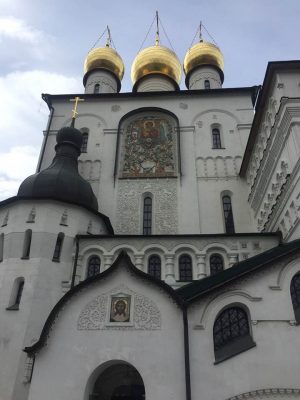
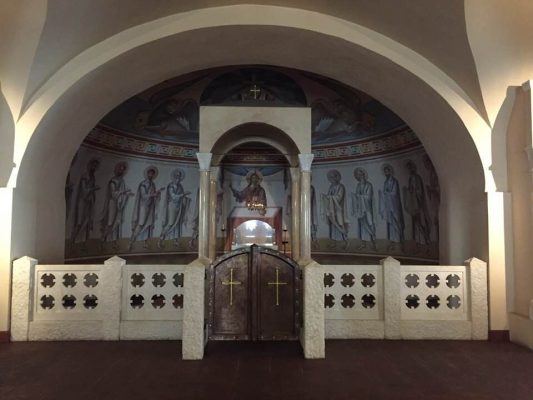
As we know, liturgy is not just texts, but the entire event, including the space, music, ritual practices, etc. The first thing I noticed upon our arrival was the church building, itself (pictured at the top of this post). Like most Russian churches, it is a rather tall and imposing structure topped with traditional cupolas. But as we entered at the ground level, I was immediately struck by the simple architecture of the small chapel. (See picture above.) The altar area was marked off by a low channel barrier in an ancient Greek style that set apart the area but still invited the participation of the assembly. This is unlike most Orthodox churches where the altar area is set apart by a wall of icons (in Russia, usually five tiers high) that, while generally quite beautiful, can hinder the communal participation of the laity. In addition, to the side of the altar was a large (adult) baptismal font. (See picture below.) It was cruciform in shape and had stairs on both sides of the main axis, allowing candidates to physically experience the death and resurrection symbolism of Baptism. As they descend the stairs, they cast of the old self. They are then immersed three times and as they ascend the stairs at the other end, are reborn into a life in Christ. One of the parishioners told me that this ancient architectural program was a deliberate attempt to present (and remember) Christianity as it came to Russia.

(Photo: Teva Regule)
The larger worship space was on the second floor. Typical of Russian churches, the ceiling was approximately three stories high. Unlike most Russian churches, the stone walls were simply decorated, albeit with a more traditional two-tier iconostasis marking off the altar area. As is usual of most churches in Russia, there are no pews. This can allow for a greater freedom of movement, although, standing for the entire service can also be tiring!
When we arrived prior to the start of the Divine Liturgy, there was already a large group of the faithful who had gathered for a group confession prior to the service. (The practice of confession prior to receiving communion is still rather tightly coupled in Russian practice. Allowing for a group confession is a pastorally sensitive way for a large number of faithful to prepare themselves to receive the Eucharist at the Liturgy.) By the start of Liturgy, the nave was filled with worshippers—young families with children, older folks, young professionals, students, etc. Some women still covered their heads as is traditional in Russian practice, but some did not. Some were well dressed; others were dressed more casually. The service began with the presiding priest intoning the opening lines of the Liturgy with the choir’s “Amen” filling the worship space. It was glorious! In general, the choral music that we heard in all Russian churches was incredibly beautiful and this was no exception. In addition, they sang a number of newer compositions reflecting a musical tradition that continues to be living. The choir was directed by a woman, one of the few formal liturgical roles open to women outside of the monastic context. Although most of the service was still celebrated in Church Slavonic (an older form of a Slavic language), the readings and sermon were proclaimed in modern Russian and some of the prayers were said aloud instead of “secretly” for a more conscious participation of the faithful. (Unfortunately, the use of the vernacular is still controversial in Russia as it is in many traditional Orthodox countries (e.g. Greece.)) The congregation was directly and actively engaged in the service by singing some of the responses, exchanging the Kiss of Peace (quite unique for most of the Orthodox world as it is a ritual that is often done just by the clergy), singing the Creed and reciting the Lord’s Prayer, prostrating during the epiclesis and praying together some of the prayers (e.g. the Prayer before Communion.) Almost the entire assembly received the Eucharist with five chalices used for distribution. Although many Orthodox churches have experienced a Eucharistic revival in the last fifty years, the practice of frequent communion of the laity is not ubiquitous. It was good to see it happening here.
The congregation was directly and actively engaged in the service by singing some of the responses, exchanging the Kiss of Peace, singing the Creed and reciting the Lord’s Prayer, prostrating during the epiclesis and praying together some of the prayers…
After the service, we were invited to “coffee hour” in the parish hall. Having this type of fellowship after the liturgy is not generally the practice in Russia. Most of the churches (at least the ones that we visited) are quite large and people tend to come in and out during the service without the communal fellowship afterwards that is usually found in Orthodox churches in the West. The parish is striving to be more than just a place where the faithful gather once a week to worship. They have a full calendar of services throughout the week, as well as study groups and other events to build up the community. Still, it is the Eucharist that is the source of their ecclesial life and the summit to which they return every week.
Much of the renewal effort that I have described above may seem rather small through the lens of the more mature liturgical movement in the West. However, in the Russian context it is notable. The parish has grown significantly since its re-inception. (People are voting with their feet!) My experience left me hopeful that it will not only continue to do so, but that others will see the value of encouraging the “full, conscious, and active” participation of all the faithful in the liturgical life of the community. Such active engagement helps us to continue to grow in that Life in Christ into which we are initiated at our Baptism.
[1] SC ¶10.
[2] SC ¶14.
[3] II:454, The bishops’ responses were published as Otzyvy eparkhial’nykh arkhiereev po voprosam o tserkovnoi reforme (St. Petersburg, 1906) in three volumes. This citation is from the second volume. It was found in the unpublished Master of Divinity thesis by John Shimchick. (John Shimchick, “The Responses of the Russian Episcopate Concerning Worship—1905 and the Liturgical Situation in America,” [master’s thesis, St. Vladimir’s Theological Seminary, 1980] 23.)
Please leave a reply.