
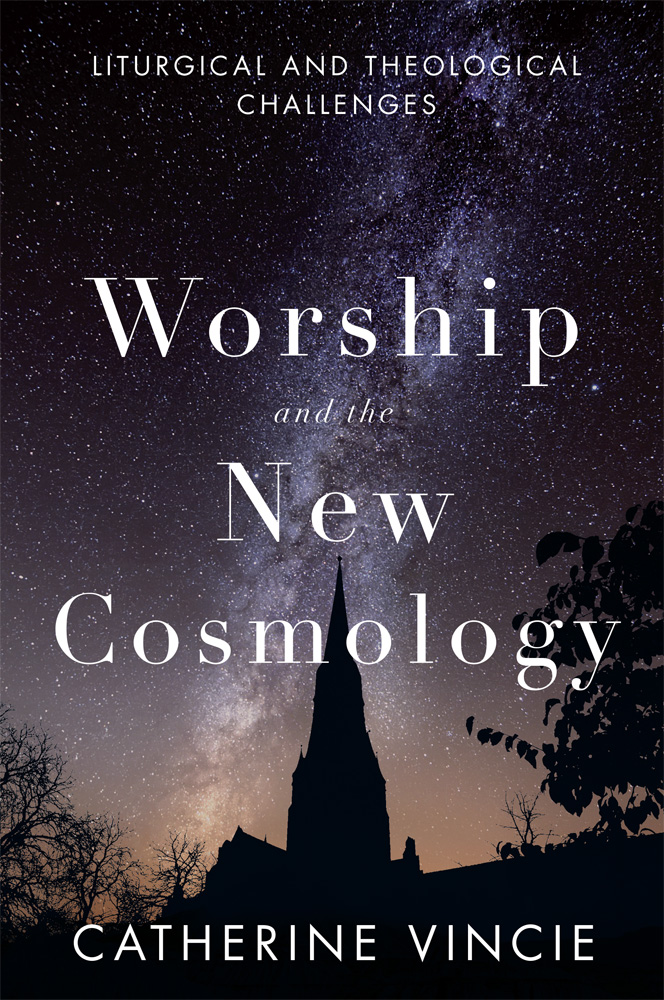
My New Book: Catherine Vincie; Worship and the New Cosmology: Liturgical and Theological Challenges

Worship and Cosmology M1.inddPray Tellย continues with this series, โ€œMy New Book,โ€ in which authors answer a few questions about their recently-released book.

Whats the point of your book, in ten words or less?

To get those working in the field of liturgy to attend to the influence of science on faith and to pay attention to the systematic theologians who already are taking the New Cosmology seriously.

What do you think is the most interesting thing you say in the book?

An evolutionary worldview and scientific cosmology changes our images of God; what and who salvation includes; and should change our communal and individual prayer.

Whats the most controversial thing you say in it?

The Roman Catholic Churchโ€™s glacial speed in inculturating and approving liturgical books puts the integration of the New Cosmology into the far distant future, and puts the Roman Church well behind other Christian denominations in this โ€œgreat work.โ€

Why should I buy your book? Who do you hope will buy it?

You should buy this book because it is the first book in liturgical studies that has taken on this topic! It gets the conversation going. We need artists, musicians, composers, prayer writers to take up the task.

Who will like your book? Who wont?

People who see the liturgy as a dynamic reality that constantly needs updating will like this book. If you are tired of change, donโ€™t read this book. Likewise if you like schizophrenia (living in a scientifically changing world and an unchanging Church world where never the twain shall meet), donโ€™t read this book!

What do you hope might change in the church because of your book?

I would love to see ICEL take up the challenge of writing new texts and incorporating them into the revised liturgical books of the Church. Not likely in the immediate future, but I have hope!

Catherine Vincieโ€™s book can be purchased throughย Liturgical Press.

Editor

Katharine E. Harmon, Ph.D., edits the blog, Pray Tell: Worship, Wit & Wisdom.

Please leave a reply.

Comments

3 responses to “My New Book: Catherine Vincie; Worship and the New Cosmology: Liturgical and Theological Challenges

  1. John Behr

    My feeling is that science revels in quantifying its uncertainties, and that’s unlikely to produce a good fit for the liturgy.
    The late-chapter examples include litanies of active research topics. Some of these may be shown wrong in a decade or two, and end up sounding silly. My feeling is that the sense of wonder is better left to amateur astronomy magazines, which at their best do capture the drive to devise tests of the more mind-expanding topics.
    E.g., there is decent evidence for “dark energy”, but it has many possible versions with no way yet to pick between them. Nor is the evidence itself conclusive. The increase in expansion rate did win a Nobel Prize, so one can be forgiven for assuming that’s ‘established’, but there are less exotic explanations proposed for the observed supernova brightness change with redshift that are still being tested. You might spark a few astronomers’ brains now by listing the example out-of-context, but in a decade you might inspire laughter instead.
    More interesting examples explore the meaning of the concepts. Time itself may have begun at a big bang, with implications worth celebrating. Yet the Jesuit Fr. Lemaitre did counsel against getting too carried away about his mathematical solution, and Adam Wood kindly links to one of several theory alternatives in a nearby post. Ps. 148 is retranslated to include the much more speculative “universes”, but there is no evidence for more than one. These concepts come from extensions of general relativity to very small distances and high energies where quantum mechanical effects should matter, but they could still be wrong, because we don’t have a tested reliable theory. The speculations are intended to provide tests for the theories.
    There is a fanciful addition of ‘invisible light’ binding atoms to the more common visible and invisible light motifs in the trial Exultet. This could be a brilliant exposition of QED, or an accident.
    Rather than presenting advanced research topics, it might be better to…

  2. John Behr

    …better to concentrate on more modest goals stated in the cosmology chapter, like capturing the sense of wonder of the Hubble Deep Field. We see thousands of galaxies there ourselves. We know the Sun is 1/3 the age of the universe, and we know few heavy elements were created at the start, so `we are stardust’ is a solid concept. Asserting the creator’s dissatisfaction until our particular dirt-bound form of life was possible is a matter of taste, but it’s built on solid science.
    It might be an improvement for liturgy to not say things in contradiction to science, though apologetics are not so hard. Ps. 19a does ok if the stars are translated as silent. “Ages beyond number” in the Christmas Proclamation is ok. “World without end” is arguably not in the Latin and has a trial replacement, while Mom gets by by redefining `world’.

    The existing Exultet has a line about supernatural things rejoicing, and then stays deliberately bound to our civilization’s few millenia. Maybe it should be left that way? There was a NOVA special in the 80’s “The Pleasure of Finding Things Out”, where Feynman gently expressed his joy at quantifying reality. (This doesn’t work as well in a recent collection with same title.) He slipped in a jarring out-of-context statement: it was ‘out of proportion’ for a God to save one planet. A vacant answer might be ‘C.S. Lewis brings it up, but the church doesn’t say anything’; can one expect a church to do better? The trial Exultet’s expansion of scale in space and time brings up many such questions. Celebrating the creation of our planet after 9 billion years ignores the likely terror of stellar destruction needed to disperse the heavy elements. A recent study suggests that the measured rate of gamma-ray bursts exterminates conditions for life in many or most galaxies. Can a few Jesuit astronomers and an occasional question to the Pontifical science Academy help the official Church grasp these things? They should try, but getting things into a solid form for liturgy is hard.

  3. Mike Morrissey

    as the English Anglican priest, who is a world renowned scientist, posited, we know the what and the how, but when we ask the “why,” we break out of the science of matter. How does original inert matter form electrical discharges which come to ask of its nature? (Please pardon my paraphrasing.)

    Even with the most powerful computers and technologies known to man, we have yet to make an amoeba. Yet when we do, it too will not be an accident, unguided by an intelligence.


Posted

in

,

by

Discover more from Home

Subscribe now to keep reading and get access to the full archive.

Continue reading